7 Tips for Hiring a Local Roofer
Discover 7 essential tips for hiring a local roofer. Learn how to check credentials, get quotes, and find reliable contractors. Get your free quote today.

Table of Contents
- Why Choosing the Right Local Roofer Matters
- 1. How to Check Roofer Credentials in the UK
- 2. Request a Detailed Roofing Quote Template
- 3. Verify Insurance and Guarantees
- 4. Ask About How Long a Roof Replacement Takes
- 5. Check References and Recent Work
- 6. Assess Responsiveness and Communication
- 7. Compare Multiple Quotes Before Deciding
- Frequently Asked Questions
Last Updated: September 22, 2026
Hiring a local roofer is one of the biggest decisions you’ll make as a homeowner. A poor choice can lead to leaks, costly repairs, and months of disruption. At Evershield Roofing, we understand what separates a reliable contractor from one that leaves you stranded. This guide covers the seven essential steps to hiring a local roofer who will deliver quality work and peace of mind.
Why Choosing the Right Local Roofer Matters
Your roof protects everything beneath it. A contractor who cuts corners on materials, skips inspections, or disappears mid-project can cost you tens of thousands in water damage alone. The right roofer, by contrast, communicates clearly, uses quality materials, and stands behind their work.
Most homeowners approach this backwards. They get one quote, like the price, and book the job. What they should do is evaluate credentials, check references, verify insurance, and compare multiple options before deciding. This takes time, but it’s the difference between a roof that lasts 25 years and one that fails in five.
Local roofers have another advantage: they understand the climate and building standards in your area. They know which materials perform best in your weather patterns and which local building codes apply to your project. They’re also more accessible when issues arise, you can reach them by phone, not through a national call centre.
1. How to Check Roofer Credentials in the UK
The first step is verifying that a roofer is qualified to do the work. This means checking credentials, certifications, and professional memberships.
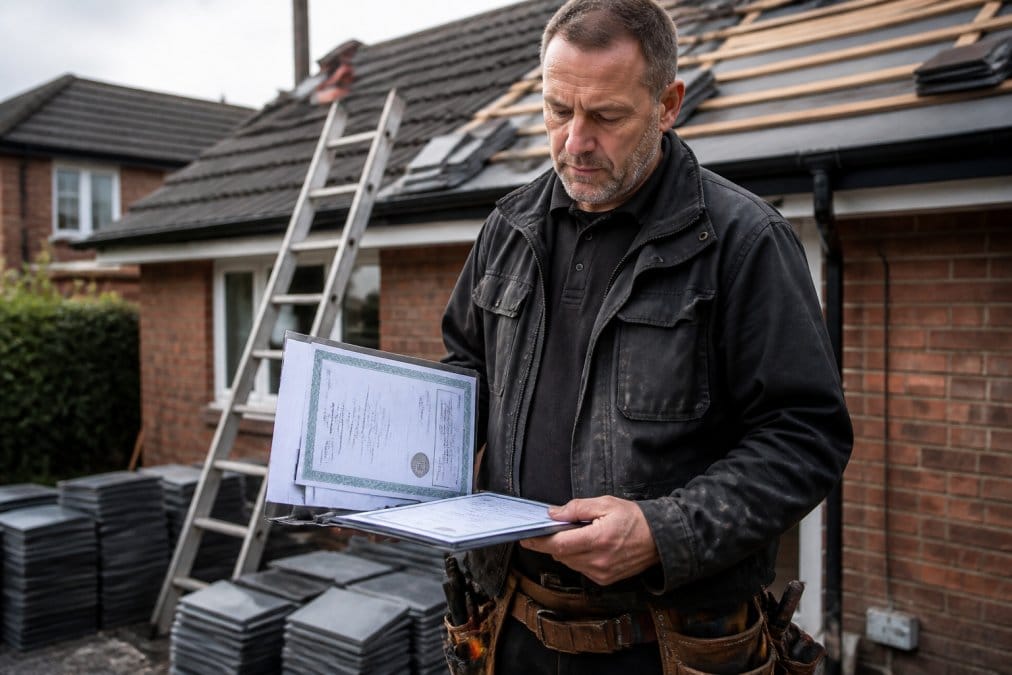
Start by asking whether the roofer is registered with a recognised trade body. In the UK, the most credible memberships are with the National Federation of Roofing Contractors (NFRC), which maintains strict standards for members, or the Confederation of Roofing Contractors (CORC). Both require members to meet rigorous technical and financial standards.
You can also verify a roofer through TrustMark, the government-endorsed quality scheme. TrustMark-registered traders have been vetted for insurance, financial stability, and compliance with UK building regulations. It’s a quick way to confirm legitimacy.
Check whether the roofer holds certifications for the specific work you need. For flat roofs, ask about EPDM or bitumen certifications. For pitched roofs, certifications in slate, tile, or asphalt are relevant. A qualified roofer will have no problem providing proof of these qualifications.
Ask how long they’ve been trading and request their Companies House registration or business registration number. This is basic due diligence. You can verify this information online and check whether the business has any formal complaints registered against it.
2. Request a Detailed Roofing Quote Template
A quote should be detailed enough that you understand exactly what work will be done, what materials will be used, and what the timeline is. Vague quotes invite problems later.
When requesting quotes, provide the same information to each roofer so you can compare fairly. Include photos of your roof, details of the damage or scope of work, and any specific requirements you have. Ask each roofer to provide a written quote that breaks down:
- Labour costs (daily rate or fixed price)
- Material costs (type and quantity of materials)
- Removal and disposal of old roofing (if applicable)
- Timeline and scheduling
- Warranty terms
- Payment schedule
A professional roofer will ask detailed questions before quoting. If someone gives you a price over the phone without seeing your roof, that’s a red flag. Every roof is different, and a proper assessment is essential.
Request the quote in writing. Email confirmation is fine. This protects you both and creates a record of what was agreed. When you’re comparing quotes later, you’ll have documentation to reference.
3. Verify Insurance and Guarantees
This is non-negotiable. A roofer without proper insurance is a liability you cannot afford.
Ask for proof of public liability insurance. This covers damage to your property or injury to people on your property during the work. Request a copy of the certificate, not just a verbal confirmation. Check that the coverage amount is adequate for the scope of work.
If the roofer will be working at height, ask about employer’s liability insurance as well. This covers their employees and is required by law if they have staff.
Ask about the guarantee on the work itself. A reputable roofer will offer a warranty, typically 5 to 10 years for materials and labour. Get this in writing. Understand what the guarantee covers. Does it include labour if something fails? Are there conditions that void the warranty? A solid guarantee is a sign of confidence in the work.
Some roofers also offer extended warranties through manufacturers. If your roofer mentions this, ask for details. These can add value, but they’re only worth something if the roofer is still in business when you need them.
4. Ask About How Long a Roof Replacement Takes
Understanding the timeline helps you plan and manage expectations. It also signals whether a roofer is being realistic or overpromising.
Get Your Free Roofing Quote Today! →
A typical roof replacement on a three-bedroom semi-detached house can take several working days, depending on weather, roof complexity, and the size of the team. A small roof repair might take a single day. A large commercial flat roof could take weeks.
Ask the roofer how long your specific project will take. Ask whether that’s weather-dependent. Rain stops most roofing work, so bad weather can extend the timeline. A roofer who gives you a fixed end date without mentioning weather is being unrealistic.
Ask how many workers will be on site and whether they’ll work five days a week or six. This affects both the timeline and the disruption to your home. Some roofers work weekends; others don’t.
Clarify what happens if the work takes longer than expected. Will you be charged extra? Is there a penalty clause if the roofer doesn’t finish on time? These details matter, especially if you’re trying to schedule other work or avoid disruption during a particular season.
5. Check References and Recent Work
References are one of the most reliable ways to assess a roofer’s quality. A contractor who has done good work will have happy customers willing to vouch for them.
Ask for at least three recent references from similar projects. “Recent” means within the last 12 months. Ask for contact details and permission to call them. When you contact a reference, ask specific questions:
- Was the work completed on time and on budget?
- Did the roofer communicate clearly throughout?
- Was the site kept clean and tidy during the work?
- Have there been any issues since the work was completed?
- Would you hire them again?
Ask the roofer for photos of recent work in your area. This shows they have local experience and gives you a visual sense of their standard. Look for clean finishes, proper flashing, and attention to detail.
You can also check online reviews on platforms like Checkatrade, Rated People, or MyBuilder. These sites verify that reviewers have actually hired the contractor, so reviews tend to be more reliable than unverified testimonials. Look for patterns. One negative review doesn’t mean much, but multiple complaints about the same issue, poor communication, unfinished work, or damage to property, are warning signs.
6. Assess Responsiveness and Communication
How a roofer communicates before the job tells you how they’ll communicate during and after. Responsiveness matters.
Call the roofer and see how quickly they answer or call you back. Do they answer questions clearly? Do they explain things in a way you understand? Or do they use jargon without explaining it? A good roofer makes the process transparent.
Ask how they prefer to communicate, phone, email, or text. Some roofers are better on the phone; others prefer written communication. Find out what works for you both. If you’re the type who needs regular updates, choose a roofer who commits to checking in regularly.
Ask what happens if issues arise during the work. Will they call you immediately, or will they wait until the end of the day? For something like a leak or structural damage discovered mid-project, you want to know they’ll flag it immediately, not surprise you with bad news after the fact.
A roofer who is hard to reach before the job will likely be hard to reach after. If there’s a problem post-completion, you want to know you can get them on the phone. This is why checking references about communication is so important.
7. Compare Multiple Quotes Before Deciding
Never hire based on one quote. Get at least three. This gives you a range and helps you spot outliers.
When comparing quotes, don’t just look at the total price.
Create a comparison table to track the key differences:
| Roofer | Total Price | Timeline | Warranty | Insurance Verified | References Provided |
|---|---|---|---|---|---|
| Roofer A | [Price] | [Days] | [Years] | Yes/No | Yes/No |
| Roofer B | [Price] | [Days] | [Years] | Yes/No | Yes/No |
| Roofer C | [Price] | [Days] | [Years] | Yes/No | Yes/No |
Pro Tip
Before signing a contract, ask the roofer to walk you through the payment schedule. Most reputable roofers ask for a deposit upfront (typically 10-20%), a progress payment mid-project, and a final payment on completion. Avoid anyone who asks for full payment upfront.
Before signing a contract, ask the roofer to walk you through the payment schedule. Most reputable roofers ask for a deposit upfront (typically 10-20%), a progress payment mid-project, and a final payment on completion. Avoid anyone who asks for full payment upfront.
Frequently Asked Questions
How do I verify a roofer’s credentials in Buckinghamshire?
Check if the roofer is registered with TrustMark, NFRC, or Checkatrade. Ask for proof of public liability insurance, employer’s liability insurance, and references from recent jobs. Request their trading history and confirm they hold any relevant certifications. A reputable local roofer will provide this information without hesitation.
What should be included in a roofing quote template?
A comprehensive roofing quote should detail the scope of work, materials to be used, labour costs, timescale, warranty terms, insurance details, and payment terms. Request itemized quotes from multiple roofers so you can compare fairly.
How long does a roof replacement typically take?
A standard roof replacement on a three-bedroom semi-detached property can take several working days, depending on weather, roof complexity, and the size of the property. Flat roofs or specialized work may take longer. Your roofer should provide a realistic timeline during the quote stage and explain any factors that could affect the schedule.
What questions should I ask before hiring a roofing contractor?
Ask about their experience with your specific roof type, warranty coverage, how they handle disruptions, whether they manage building control inspections, and their policy if issues arise after completion. Also clarify payment terms, whether they offer financing options, and their availability for emergency repairs. A responsive contractor should answer these clearly.