Benefits of Installing a Warm Flat Roof
Discover the benefits of installing a warm flat roof, from lower heat loss to fewer condensation problems. Compare warm vs cold and see what affects cost.

Table of Contents
- How a Warm Flat Roof Works and Why It Cuts Heat Loss
- Warm Roof vs Cold Roof: Which Suits Your Property?
- Warm Flat Roof Construction: What Happens on Installation Day
- Flat Roof Insulation: Choosing the Right Material and Thickness
- Warm Flat Roof Cost UK: What Affects the Price
- Condensation, Drainage and Long-Term Performance
- Frequently Asked Questions
Last Updated: October 12, 2026
How a Warm Flat Roof Works and Why It Cuts Heat Loss
A warm flat roof is a roof build-up where the insulation sits above the structural deck and directly beneath the waterproof membrane, so the deck stays warm and dry. That single design decision explains most of the benefits of installing a warm flat roof: less heat escapes, the structure is protected from condensation, and the waterproofing lasts longer because it is not sitting on a cold, damp surface.
At Evershield Roofing, we have fitted and repaired flat roofs in Buckinghamshire for over 25 years, and the pattern is always the same. Cold roofs fail quietly from the inside. Warm roofs fail far less often, and when they do, the cause is usually a workmanship detail rather than the design itself.
Here is what most guides get wrong: they present warm and cold roofs as two equally valid options. In practice, one of them has been the sensible default for new flat roof work for years.
Building Research Establishment guidance on flat roof construction
Warm Roof vs Cold Roof: Which Suits Your Property?
For almost all new flat roof installations and full replacements, a warm roof is the better choice. A cold roof places insulation between the joists, leaving the deck cold and relying on ventilation gaps to carry moisture away. Those gaps are hard to maintain properly, and when they underperform, condensation builds inside the roof where you cannot see it.
A warm roof moves the insulation above the deck. The structure stays at roughly room temperature, moisture has nowhere cold to condense, and the membrane sits on a solid, insulated base instead of a ventilated void.
Where a cold roof can still make sense:
- Some older properties where the existing build-up cannot be altered without major structural work
- Situations where raising the roof height is genuinely not possible
- Certain heritage or conservation settings where external changes are restricted
For everything else, warm wins on performance, lifespan and simplicity.
Warm Flat Roof Construction: What Happens on Installation Day
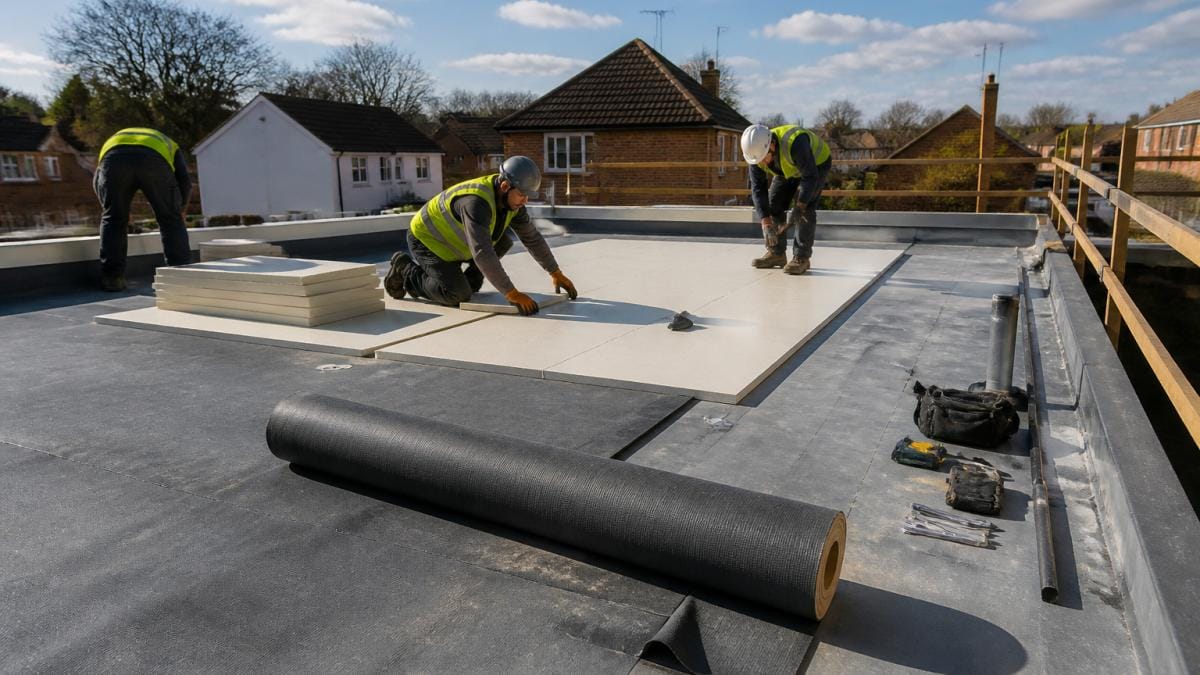
A warm flat roof construction follows a fixed sequence: strip back the old covering, inspect and repair the deck, lay a vapour control layer, fit rigid insulation boards, then install the waterproof membrane on top.
Preparing the Existing Deck
Everything depends on the deck. We strip the old felt or membrane, then check the boards for soft spots, water damage and rot. Any failed sections are replaced before anything else goes down. Skip this step and you are insulating over a problem that will find its way back.
We also check falls and drainage at this stage. Standing water is the single most common reason flat roofs fail early, and it is far cheaper to correct the slope now than to return in two years.
Laying Insulation and Waterproofing
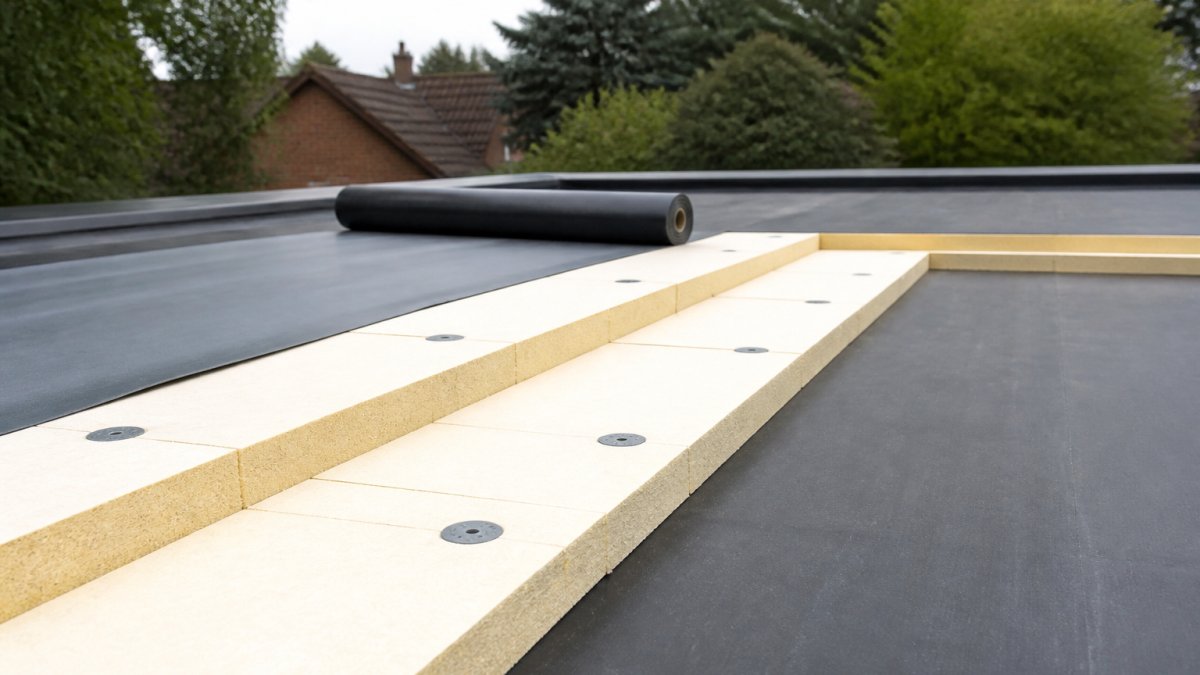
A vapour control layer goes down first, then rigid insulation boards are laid in a staggered pattern and mechanically fixed. The membrane, whether felt, EPDM or GRP, is then installed over the top and sealed at every edge, upstand and outlet.
The sequence matters more than the materials. A premium membrane fitted over a poorly prepared deck will still fail.
Flat Roof Insulation: Choosing the Right Material and Thickness
Flat roof insulation is the layer that does the actual work, and the material you choose affects both thermal performance and build height. PIR boards are the usual pick because they deliver strong thermal performance at a thinner profile, which matters when you cannot raise the roof much. Mineral wool costs less but needs more depth for the same result.
Get Your Free Roofing Quote Today! →
Thickness is governed by Building Regulations, which set minimum thermal standards for roof work. The exact figure depends on your build-up, so we calculate it per property rather than quoting a generic number.
Pro Tip
If you are replacing a flat roof anyway, upgrade the insulation at the same time. Doing both in one visit costs far less than coming back to it later, and it is the cheapest heat loss you will ever fix.
If you are replacing a flat roof anyway, upgrade the insulation at the same time. Doing both in one visit costs far less than coming back to it later, and it is the cheapest heat loss you will ever fix.
Warm Flat Roof Cost UK: What Affects the Price
Warm flat roof cost homeowners ask about most often comes down to four things: roof size, deck condition, insulation specification and membrane type. There is no honest single figure, because two roofs of the same size can differ hugely once the deck is exposed.
What moves the price:
- Area. Larger roofs need more material and more labour days.
- Deck repairs. Replacing rotted boards adds time and cost.
- Insulation spec. Higher-performance boards cost more per square metre.
- Membrane choice. EPDM, GRP and felt each carry different material and labour costs.
- Access and height. Scaffolding and awkward access add to the job.
We provide free surveys and quotes, so you get a figure based on your actual roof rather than a phone estimate. Finance is available from 0% APR if you would rather spread the cost.
GOV.UK guidance on building regulations approval
Condensation, Drainage and Long-Term Performance
Two things determine whether a warm flat roof lasts: moisture control and water run-off. Get both right and the roof should give decades of service. Get either wrong and you will be calling someone back within a few years.
Condensation is controlled by the vapour control layer and by keeping the insulation above the deck. Drainage is controlled by falls, outlets and keeping gullies clear. If you have standing water sitting on a flat roof for weeks, that is not a minor cosmetic issue, it is a warning.
Watch Out
Never let a contractor lay new insulation over a wet deck or skip the vapour control layer. Trapped moisture has nowhere to go, and the membrane above it will blister and fail long before its time.
Never let a contractor lay new insulation over a wet deck or skip the vapour control layer. Trapped moisture has nowhere to go, and the membrane above it will blister and fail long before its time.
If you are searching for flat roof specialists near me, ask two questions before you book anyone: how do you check the deck, and how do you handle drainage. The answers tell you more than any quote.
We also handle guttering and roof repairs, so you are not juggling separate trades.
A flat roof that pools water, drips into a ceiling or has been patched one time too many will not fix itself, and every wet month makes the deck worse. Evershield Roofing has spent 25 years fitting flat roofs in Buckinghamshire and across London, backed by free surveys and quotes, full insurance, finance from 0% APR, and an emergency repair service when water is already coming in. Get started with Evershield Roofing and get a flat roof that keeps the heat in and the water out.
Frequently Asked Questions
What is a warm flat roof?
A warm flat roof places the insulation above the structural deck, with the waterproof membrane on top of the insulation. This keeps the deck at a temperature closer to the inside of the building, so it stays warm and dry. Because the insulation sits on the cold side of the structure, there is far less risk of condensation forming underneath the membrane than with a cold roof, where insulation sits between the joists.
Does a warm flat roof help reduce heat loss?
Yes. Because the insulation sits above the deck with no gaps for cold bridging, a warm flat roof keeps more heat inside the building than a cold roof. The exact saving depends on the insulation thickness and the U-value you choose. Better flat roof insulation also means the rooms below stay warmer in winter, which can reduce how hard your heating has to work. Ask your roofer to confirm the U-value meets current Building Regulations before work starts.
Is a warm flat roof suitable for an existing flat roof?
In most cases, yes. A warm flat roof can be installed over an existing flat roof, provided the deck is structurally sound and the roof has enough height for the extra insulation and membrane. A survey will confirm whether the existing deck and joists can take the additional weight. If the roof is already leaking or the deck is rotten, the affected sections will need to be replaced first.
How much does it cost to install a warm flat roof in the UK?
The cost depends on the roof size, the insulation material and thickness, the membrane system, and whether the existing deck needs repairs. Access, drainage and any additional work such as replacing fascias or guttering also affect the total. Evershield Roofing offers free surveys and quotes, so you get a fixed figure for your property rather than a rough estimate. Finance is available from 0% APR to spread the cost.