
Cost of Full Roof Replacement UK 2026: Complete Pricing Guide
Cost of full roof replacement UK 2026: Full roof replacement cost UK 2026: pricing by material, labour, factors affecting quotes. Get your free estimate.

Table of Contents
- Understanding the Cost of Full Roof Replacement in the UK
- Key Factors Affecting Your Roof Replacement Cost
- Types of Roofing Materials UK Cost Breakdown
- Roof Replacement Cost Per Square Metre UK
- How Long to Replace a Roof in the UK: Timeline and Labour
- Building Regulations, Planning Permission, and Compliance
- Roofing Grants UK 2026: Funding Your Replacement
- Hidden Costs: Fascias, Soffits, Guttering, and Waste Disposal
Last Updated: July 31, 2026
Understanding the Cost of Full Roof Replacement in the UK
The cost of full roof replacement UK 2026 varies significantly depending on your home’s size, roof type, and material choices. At Evershield Roofing, we understand that understanding the true cost, not just the headline figure, is essential before committing to work.
This guide breaks down every factor that influences roof replacement pricing, from labour costs and material selection to hidden expenses like scaffolding and waste disposal. We’ll walk you through the real numbers, explain what drives those costs up or down, and show you how to get accurate quotes from reputable contractors in your area.
The reason cost estimates vary so widely is simple: no two roofs are identical. A terraced house with a simple pitched roof will cost far less to replace than a sprawling detached property with multiple roof angles, valleys, and complex structural requirements. Understanding these variables helps you budget realistically and avoid unpleasant surprises when contractors arrive on site.
Key Factors Affecting Your Roof Replacement Cost
Several specific variables determine whether your roof replacement bill sits at the lower or upper end of the scale. The most obvious is house type and roof size, but structural complexity, site access, and material durability all play equally important roles in the final quote.
House Type and Roof Size
A semi-detached house typically requires less roofing material than a detached property, which means lower material and labour costs. Terraced houses are often the most economical to replace because of their smaller roof footprint and straightforward design. Detached homes, conversely, often have more complex roof shapes with multiple pitches, dormers, or gables, features that add hours to the labour schedule and increase material waste.
The actual roof area measured in square metres directly correlates to cost. A modest three-bedroom semi might have a roof area of 80-100 square metres, while a large detached house could exceed 150 square metres. Every additional square metre means more slate, tiles, or membrane, plus more labour hours for installation.
Roof Pitch and Structural Complexity
Steeper roof pitches are more challenging and dangerous to work on, requiring additional safety equipment and slower work rates. A roof pitched at 45 degrees takes significantly longer to replace than a shallow 25-degree pitch. Valleys where two roof sections meet, hips, and ridge details all add complexity that contractors must price into their quotes.
Structural issues discovered during removal, rotten timber, damaged rafters, or inadequate ventilation, can push costs up substantially. Some properties require structural repairs before new roofing can be installed. This is why a professional roof survey before accepting a quote is essential; it prevents nasty surprises mid-project.
Scaffolding and Site Access
Many properties require temporary scaffolding during roof work, adding £800 to £2,000 to the project cost depending on the house size and how long scaffolding is needed. Properties with difficult access, narrow driveways, limited parking, or restricted working space, may incur additional charges for crane hire or specialized equipment. Urban properties in London and Buckinghamshire often face tighter site constraints than rural homes.
Types of Roofing Materials UK Cost Breakdown
Your material choice is the second-largest cost driver after labour. Different materials offer different lifespans, aesthetic appeal, and maintenance requirements, all factors that influence the total cost of full roof replacement UK 2026.
Pitched Roof Materials: Slate, Clay Tiles, and Concrete Tiles
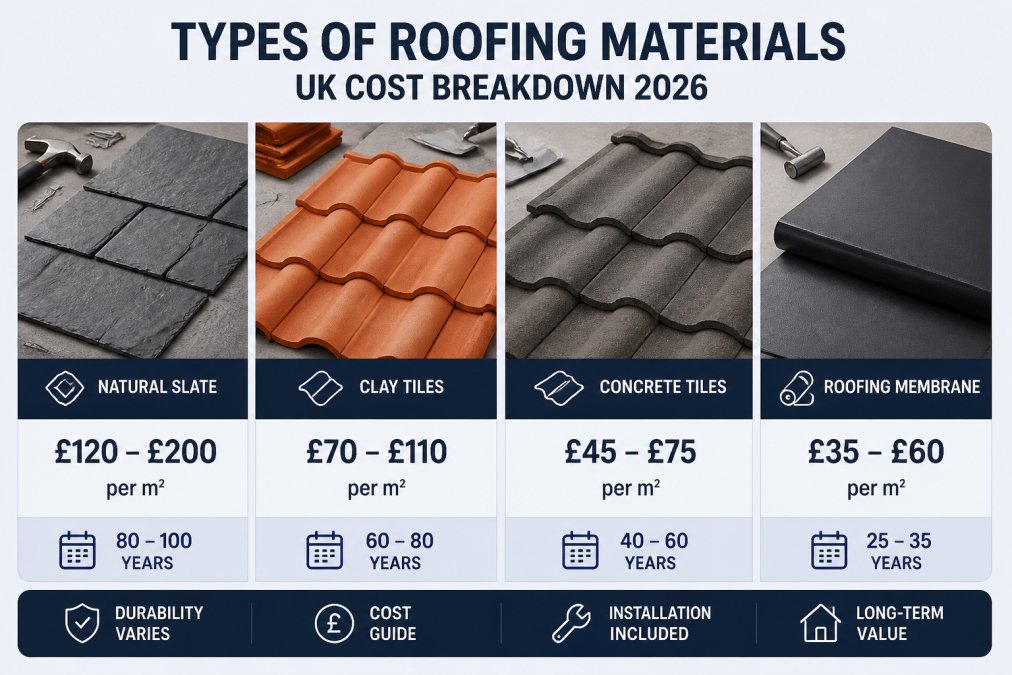
Natural slate is the premium choice, offering a lifespan of 100+ years and unmatched aesthetic appeal. However, slate costs roughly £1,200-£1,800 per square metre installed, making it the most expensive pitched roof option. It’s durable enough that the material cost is often justified over the roof’s lifetime, but the upfront investment is substantial.
Clay tiles are a middle-ground option, lasting 60-80 years with costs around £800-£1,200 per square metre. They’re traditional, attractive, and widely available across the UK. Many period properties in Buckinghamshire use clay tiles because they complement the architectural style.
Concrete tiles are the most budget-friendly pitched option at £400-£700 per square metre, lasting 40-50 years. They’re durable, come in various colours, and are quick to install. For homeowners prioritizing cost over longevity, concrete tiles make practical sense.
Flat Roof Materials: Membrane and Felt Systems
Flat roofs typically use roofing membranes (EPDM, TPO, or PVC) or traditional felt systems. Modern roofing membranes cost £600-£900 per square metre and last 25-40 years. They’re more durable than older felt systems and require less maintenance.
Traditional bituminous felt is cheaper at £300-£500 per square metre but needs replacement every 15-20 years, making it less economical long-term. Many commercial properties in Buckinghamshire still use felt, but residential replacements increasingly favour membrane systems for better durability.
Roof Replacement Cost Per Square Metre UK
Breaking costs down by square metre gives a clearer picture of what you’re paying for labour versus materials. A typical installation cost per square metre ranges from £150-£350 for labour, depending on roof complexity and contractor experience.
Material costs per square metre vary dramatically by type: concrete tiles at £400-£700, clay tiles at £800-£1,200, slate at £1,200-£1,800, and membranes at £600-£900. Add labour, and a pitched roof replacement typically costs £550-£2,100 per square metre fully installed.
For a 100-square-metre roof with concrete tiles, expect a total of £55,000-£70,000. The same roof in slate could reach £120,000-£180,000. These figures include materials, labour, scaffolding, and basic disposal, but exclude structural repairs or premium finishes.
Pro Tip
Request a cost breakdown per square metre from your contractor. This transparency helps you compare quotes fairly and identify where one contractor is overcharging relative to others. Evershield Roofing provides detailed per-square-metre pricing in all quotes.
Request a cost breakdown per square metre from your contractor. This transparency helps you compare quotes fairly and identify where one contractor is overcharging relative to others. Evershield Roofing provides detailed per-square-metre pricing in all quotes.
How Long to Replace a Roof in the UK: Timeline and Labour
Project duration affects labour costs directly, so understanding typical timescales helps you budget accurately and plan for disruption to your home.
Labour Costs and Daily Rates
Most UK roofers charge between £150-£250 per day per worker, though experienced specialists may charge more. A typical roof replacement requires 2-4 workers depending on complexity. A straightforward 100-square-metre pitched roof with concrete tiles might take 10-15 working days, meaning labour costs of £3,000-£9,000 depending on team size and experience.
Flat roofs often take longer per square metre because membrane installation requires precision and careful sealing. A 100-square-metre flat roof might take 12-18 days, pushing labour costs toward the higher end.
Typical Project Duration by Roof Type
A simple pitched roof on a terraced house typically takes 5-10 working days. Semi-detached properties with slightly larger roofs and one or two dormers usually need 10-15 days. Large detached houses with multiple roof angles, valleys, and complex details often require 20-30 working days.
Flat roofs, particularly those requiring membrane installation, typically take 12-20 working days depending on size and existing roof condition. Weather delays are common, roofers cannot work safely in heavy rain or high winds, so add 20-30% extra time to your project schedule as a buffer.
Building Regulations, Planning Permission, and Compliance
Most roof replacements in the UK don’t require planning permission, but they must comply with Building Regulations. This is a critical distinction that many homeowners overlook.
A roof replacement is classified as a "controlled work" under Building Regulations. You must notify your local authority (in Buckinghamshire, this is Buckinghamshire Council) before work starts, or within 30 days of completion. Failure to comply can affect future property sales and insurance claims.
Your contractor should be either a registered NICEIC or FENSA installer, or you must arrange for a Building Control inspector to assess the work. The inspection focuses on structural integrity, insulation standards (particularly if upgrading to modern insulation), and proper ventilation. Current regulations require pitched roofs to achieve a U-value of 0.16 W/m²K for new installations, which typically means adding insulation during replacement.
Watch Out
Skipping Building Regulations compliance can cost you dearly. A future buyer’s surveyor will flag non-compliant work, and you may be forced to pay for remedial work before sale. Always ensure your contractor registers the work with Building Control.
Skipping Building Regulations compliance can cost you dearly. A future buyer’s surveyor will flag non-compliant work, and you may be forced to pay for remedial work before sale. Always ensure your contractor registers the work with Building Control.
Roofing Grants UK 2026: Funding Your Replacement
Several funding options exist for roof replacement, particularly if your work improves energy efficiency. The Energy Company Obligation scheme provides grants for energy-efficiency improvements, including roof insulation upgrades during replacement. Eligibility depends on your property type and energy supplier.
Local authority grants vary by region. Buckinghamshire Council sometimes offers grants for properties meeting specific criteria, though availability changes year to year. Contact your local council’s housing department to check current schemes.
The Warm Home Discount scheme provides bill rebates rather than grants, but it can help offset costs for eligible households. Green financing options through specialist lenders offer below-market interest rates for energy-efficiency improvements, including roof replacement with insulation upgrades.
Some contractors, including Evershield Roofing, offer flexible financing options that make larger projects more manageable. Interest-free payment plans spread costs over 12-24 months, removing the burden of a single large upfront payment.
Hidden Costs: Fascias, Soffits, Guttering, and Waste Disposal
The headline roof replacement cost often excludes peripheral work that’s essential for a complete, weatherproof installation. Understanding these hidden costs prevents budget surprises.
Fascias and Soffits
Fascias (the boards that run along the roof edge) and soffits (the underside panels) often need replacement when a roof is replaced, particularly if they’re rotten or damaged. New fascias and soffits typically cost £1,200-£3,000 depending on the property’s perimeter and material choice (uPVC, timber, or aluminium). This work is often discovered during roof removal, so contractors may quote it separately.
Guttering
If your guttering is old or damaged, replacement during a roof project makes practical sense, you’re already scaffolded up and accessing the roof edge. New guttering typically costs £600-£1,500 for a modest property. Cast iron guttering is more expensive but offers period authenticity; modern uPVC is cheaper and lower-maintenance.
Waste Disposal and Skip Hire
Removing old roofing material generates substantial waste. A skip for a typical roof replacement costs £200-£500 depending on size and location. Some contractors include skip hire in their quote; others charge separately. Recycling old slate or tiles (rather than landfill disposal) may cost slightly more but is increasingly expected for environmental reasons.
Chimney Repairs
If your property has a chimney, the roof replacement work often reveals deterioration around the chimney base. New lead flashing around chimneys costs £300-£800 depending on chimney size. Damaged chimney brickwork may need pointing or rebuilding, adding £500-£2,000 to the project.
Key Takeaway
Request an itemized quote that separates the main roof work from fascias, soffits, guttering, and waste disposal. This clarity helps you prioritize work and spread costs across phases if budget is tight.
Request an itemized quote that separates the main roof work from fascias, soffits, guttering, and waste disposal. This clarity helps you prioritize work and spread costs across phases if budget is tight.
Vetting Contractors: Finding a Reliable Roofer Near You in Buckinghamshire
Getting multiple quotes is essential, but knowing how to evaluate contractors separates the reliable from the cowboys. Look for contractors with verifiable experience, proper insurance, and transparent pricing.
Check whether the contractor holds NICEIC or FENSA registration. These bodies require ongoing training and quality standards. Ask for references from recent roof replacements in your area, contractors should provide at least three contact details you can call.
Insurance is non-negotiable. Verify that the contractor carries public liability insurance (minimum £1 million) and employers’ liability if they employ workers. Request a copy of the insurance certificate before work starts.
Evershield Roofing has over 25 years of experience in Buckinghamshire and London, with a team trained to current Building Regulations standards. We provide free surveys and detailed quotes, and we’re available for emergency repairs if weather damage strikes before planned replacement work.
Compare quotes on a like-for-like basis: same materials, same scope of work, same timeline. A quote significantly lower than others may indicate corners being cut or hidden costs lurking. A quote significantly higher may reflect premium materials or unnecessary extras.
Replacing a roof is one of the largest home improvements you’ll undertake, and understanding the cost of full roof replacement UK 2026 helps you make informed decisions. Material choice, labour rates, site complexity, and hidden costs all influence the final bill, but working with an experienced, transparent contractor removes much of the uncertainty.
Evershield Roofing offers free surveys and detailed cost breakdowns tailored to your specific property. We handle the entire process, from Building Regulations compliance to disposal, so you’re protected throughout the project. Contact us today for your free roofing quote and discover how we can help protect your home with a strong, long-lasting roof.
Frequently Asked Questions
What is the average cost of a full roof replacement in the UK in 2026?
The cost of full roof replacement UK varies significantly based on house size, roof type, and materials chosen. A semi-detached property typically costs more than a terraced house, whilst a detached home with a complex pitched roof will be at the higher end. Labour costs, material costs, scaffolding, and waste disposal all contribute to the final quote. For an accurate figure, request a free survey and estimate from an experienced roofing contractor who can assess your specific structural integrity, roof pitch, and any additional work like fascias, soffits, and guttering repairs.
How long does a full roof replacement take in the UK?
How long to replace a roof in the UK depends on roof size, pitch, and material type. A straightforward pitched roof replacement on a semi-detached house typically takes 5-10 working days, whilst a complex slate roof or flat roof conversion may take 2-3 weeks. Weather delays, structural repairs discovered during removal, and the need for scaffolding can extend timelines. Your contractor should provide a realistic schedule during the planning stage, accounting for waste disposal and any additional work on fascias, soffits, or guttering.
Do I need planning permission for a new roof in the UK?
Most standard roof replacements like-for-like do not require planning permission under UK building regulations, as long as the new roof matches the original in size, shape, and material. However, if you're changing the roof type (e.g., converting a pitched roof to a flat roof), adding dormer windows, or altering the roofline significantly, you will need planning permission. Listed buildings and properties in conservation areas have stricter rules. Always check with your local authority before starting work, and ensure your contractor is familiar with building regulations compliance for structural integrity, insulation, ventilation, and waterproofing.
What factors influence the cost of a new roof in the UK most significantly?
The primary factors affecting roof replacement cost UK are: roof size and pitch (steeper roofs cost more due to safety and scaffolding); material choice (natural slate is premium, concrete tiles mid-range, felt budget-friendly); house type (detached homes often cost more than terraced); labour rates (daily rates vary by region and contractor experience); and hidden costs like fascias, soffits, guttering replacement, skip hire, and waste disposal. Structural repairs, underlay upgrades, insulation improvements, and lead flashing work add further expense. Request itemised quotes to understand exactly what you're paying for.
What is the roof replacement cost per square metre UK in 2026?
Roof replacement cost per square metre UK varies by material and labour. Concrete tiles typically cost less per square metre than natural slate or clay tiles. Labour costs are usually quoted as a daily rate rather than per square metre, making total cost dependent on project duration. Flat roofs with modern roofing membrane can differ significantly from pitched roofs in pricing structure. Always request a detailed breakdown showing material costs, labour costs, scaffolding, and waste disposal separately so you understand the per-square-metre value and can compare quotes fairly.
Are there grants or schemes available for roof replacement in the UK in 2026?
Roofing grants UK 2026 eligibility depends on your circumstances. Some energy efficiency schemes may help with insulation upgrades during roof replacement, though dedicated roof grants are limited. Homeowners on low incomes may qualify for support through local authority schemes or charitable programmes. Always check with your local council and the UK government's energy support pages for current eligibility. Contractors experienced with grant applications can advise whether your project qualifies, and some may help with the paperwork.
What makes one roofing contractor better than another when getting quotes?
Choose a contractor with proven experience, verifiable references, and transparent pricing. Check they're fully insured, provide detailed written quotes including labour costs, material costs, scaffolding, and waste disposal, and offer a warranty on workmanship. Ask for a roof survey and inspection before quoting, this shows professionalism. Responsive communication is critical: a contractor who answers the phone promptly and explains the process clearly is more reliable than one who's hard to reach. Avoid contractors who pressure you into immediate decisions or quote significantly lower than others without justification.