Eco Friendly Roofing Alternatives for UK Homes: 2026 Guide
Compare eco friendly roofing alternatives for UK homes, from sedum to solar shingles. Learn costs, planning rules and benefits. Get your free quote today.

Table of Contents
- Why UK Homeowners Are Switching to Eco Friendly Roofing
- The Main Eco Friendly Roofing Alternatives Compared
- Benefits of Green Roofs UK Homeowners Should Know
- What Drives the Cost of Sustainable Roofing Materials
- Planning Permission for Eco Roofs in Buckinghamshire
- Which Eco Roofing Option Fits Your Home?
- Conclusion: Making the Right Eco Roofing Choice
- Frequently Asked Questions
Last Updated: September 16, 2026
Why UK Homeowners Are Switching to Eco Friendly Roofing
Eco friendly roofing is any roof covering chosen for lower environmental impact across its life, from material sourcing and manufacturing through to disposal or recycling. According to the UK Green Building Council’s guidance on sustainable homes, the built environment accounts for a significant share of UK carbon emissions, which is pushing homeowners to look harder at what sits over their heads. At Evershield Roofing, we survey roofs across Buckinghamshire every week, and the shift is obvious: homeowners are increasingly asking what will last, insulate and drain properly. Below, we compare the main eco friendly roofing alternatives for UK homes, what each costs to run and maintain, and which suits your property. But first, here’s what most guides get wrong: they rank materials by green credentials alone, when weight, pitch and planning rules decide what you can actually fit.
The Main Eco Friendly Roofing Alternatives Compared
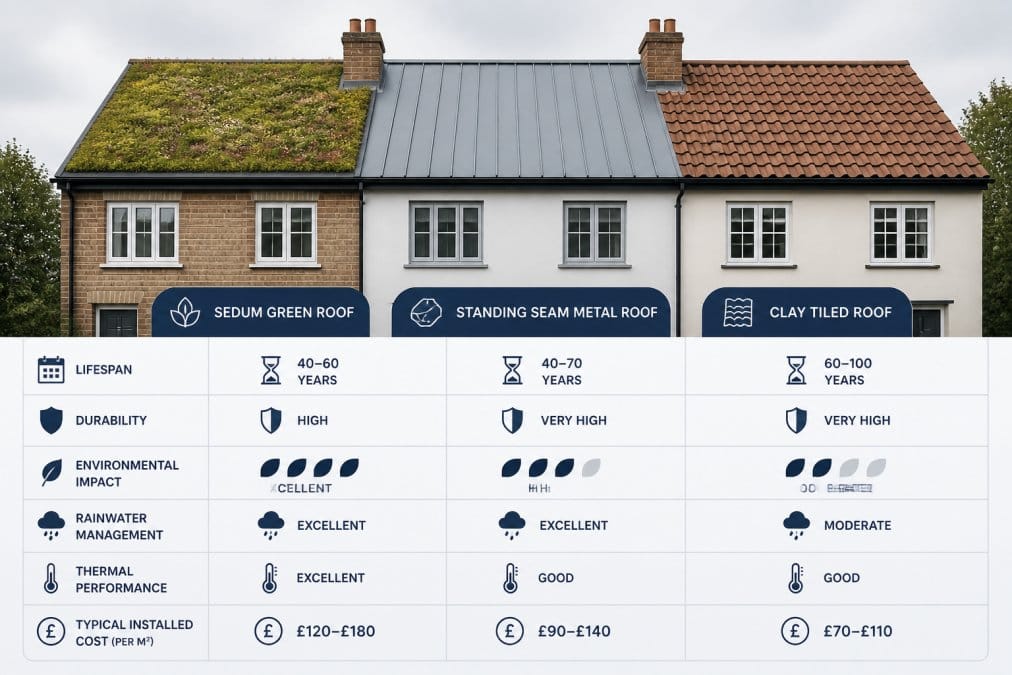
The right eco roof for a UK home depends on three things: your roof structure’s load capacity, the pitch of your roof, and whether you need planning consent. The table below summarises how the main options compare.
| Option | Typical Lifespan | Key Strength | Main Drawback | Best For |
|---|---|---|---|---|
| Sedum living roof | 40+ years | Insulation and biodiversity | Needs structural check | Flat or low-pitch roofs |
| Standing seam metal | 50+ years | Fully recyclable, lightweight | Noisy in heavy rain | Modern homes |
| Clay tile | 100+ years | Natural, reusable | Very heavy | Heritage properties |
| Concrete tile | 50+ years | Affordable, durable | Heavy framing needed | Budget replacements |
| Composite slate | 40-50 years | Light, slate look | Less character | Slate-style on a budget |
| Solar shingles | 25-30 years | Generates electricity | High upfront cost | Net-zero ambitions |
| Recycled rubber | 30-40 years | Diverts tyre waste | Limited availability | Flat roofs, outbuildings |
| Cedar shakes | 30-50 years | Renewable, insulates well | Needs maintenance | Period and rustic homes |
Living Roofs and Sedum Systems
A living roof, often called a green roof, is a roof surface planted with vegetation over a waterproof membrane and drainage layer. Sedum is the most common choice in the UK because it tolerates drought and needs little feeding once established. The benefits of green roofs include quieter rooms, slower rainwater runoff and a roof membrane that lasts longer because it is shielded from UV. The catch is weight: saturated soil is heavy, so a structural assessment is essential before installation.
Metal, Clay, Concrete and Composite Options
Metal, clay, concrete and composite coverings are the workhorses of eco friendly roofing, and each trades weight against lifespan. Standing seam metal is the lightest and most recyclable, though it needs good insulation to stay quiet in heavy rain. Clay and concrete tiles are heavy but extremely durable, and clay in particular can be reused for a century or more. Composite slate sits in the middle: lighter than natural slate, made partly from recycled material, and consistent in colour.
Solar Shingles and Recycled Rubber
Solar shingles, also called building-integrated photovoltaics, replace tiles entirely and generate electricity from the roof surface. They suit homeowners aiming for near-zero energy bills, but the upfront investment is the highest of any option here. Recycled rubber shingles offer the opposite proposition: made from post-consumer tyres, tough against impact and frost, and usually the cheapest way to get a slate look on a flat or low-pitch roof.
Benefits of Green Roofs UK Homeowners Should Know
The benefits of green roofs include thermal buffering, stormwater management and biodiversity. A sedum roof absorbs rainfall that would otherwise hit your gutters and drains, which matters on a Buckinghamshire property during summer downpours. The planting layer also shades the waterproof membrane beneath, and that shading is what extends the membrane’s working life. There is a planning angle too: official government guidance on sustainable drainage encourages measures that slow surface water, and green roofs count towards that. What most guides miss is that these benefits only appear if the roof is built up correctly, with the right drainage layer and a structural sign-off.
What Drives the Cost of Sustainable Roofing Materials
The cost of sustainable roofing materials is driven by four factors: material weight and transport, structural reinforcement, labour complexity, and lifespan. A lightweight metal roof usually needs less reinforcement than clay or concrete, which keeps the total lower even when the material itself costs more per square metre. Living roofs add waterproofing, drainage and planting layers, so the build-up is longer and the labour higher. Solar shingles bundle roofing and energy generation into one purchase, which raises the upfront figure but offsets it over time. Because prices vary by specification, roof size and access, Evershield Roofing provides a free survey and a written quote rather than a fixed online figure, and finance is available from 0% APR to spread the cost.
Planning Permission for Eco Roofs in Buckinghamshire
Planning permission for eco roofs in Buckinghamshire usually is not required, provided the work is a like-for-like repair or replacement and does not change the roof’s shape or height. Most roof replacements fall under permitted development rights. Problems arise in three situations: listed buildings, homes in a conservation area, and flats or maisonettes where the roof is shared. In those cases you need consent before work starts, and using materials that match the original is normally a condition. If you are unsure, check with the local planning authority before ordering materials, because removing an unauthorised roof can be far more expensive than the application itself.
Get Your Free Roofing Quote Today! →
Which Eco Roofing Option Fits Your Home?
Choosing comes down to four questions: what is your roof pitch, how much weight can the structure take, what is your budget, and do you want the roof to generate energy? Flat or low-pitch roofs point towards sedum, rubber or cool roof systems. Pitched roofs on period properties suit clay or cedar, while modern homes take metal or composite slate well. If energy generation is the goal, solar shingles are the only option that pays back through the meter. For homeowners searching for eco friendly roofing near me in London or across Buckinghamshire, the practical step is a survey that measures pitch, load and drainage before any material is specified.
Pro Tip
Ask your roofer to photograph the existing battens and membrane during the survey. On older Buckinghamshire homes, failing battens are often hidden under the tiles and only appear once the covering is stripped, which changes the quote after work has started.
Ask your roofer to photograph the existing battens and membrane during the survey. On older Buckinghamshire homes, failing battens are often hidden under the tiles and only appear once the covering is stripped, which changes the quote after work has started.
Conclusion: Making the Right Eco Roofing Choice
The hard part is not picking a green material, it is matching that material to your roof’s structure, pitch and planning status. Evershield Roofing has spent 25 years fitting and repairing roofs across Buckinghamshire, and we handle the survey, the structural assessment and the installation as one job. We offer free surveys and quotes, finance from 0% APR, and emergency roof repair when a leak will not wait. Get started with Evershield Roofing and get a roof that protects your home and lowers its running costs.
Frequently Asked Questions
What is the most eco friendly roofing material for UK homes?
There is no single winner because it depends on your priorities. Sedum green roofs offer the best biodiversity and rainwater management. Standing seam metal roofing is 100% recyclable and lasts 50 years or more. Clay tiles are made from abundant natural material and can last over 100 years. If energy generation matters most, solar shingles produce electricity directly. For most UK homeowners, the best choice balances lifespan, recyclability and how well the material suits the existing structure.
Are green roofs suitable for the Buckinghamshire climate?
Yes. Sedum green roofs are designed for temperate UK conditions and handle both wet winters and dry summers well. The plants are drought-resistant once established and need little watering. The main consideration is structural: saturated soil is heavy, so a survey is needed to confirm your roof can carry the load. A roofing specialist can assess this during a free survey before any work begins.
Do I need planning permission for a green roof in the UK?
Green roofs often fall under permitted development rights, meaning no full planning application is needed in many cases. However, flats and maisonettes lose those rights, and properties in conservation areas or listed buildings usually need consent. In Buckinghamshire, it is worth checking with the local planning authority before committing. A reputable roofing company can guide you through what applies to your specific property.
How long do sustainable roofing materials last compared to traditional tiles?
Many eco alternatives outlast standard options. Clay tiles can last over 100 years, standing seam metal typically 50 years or more, and composite slate tiles resist cracking far better than natural slate. Green roofs extend the life of the waterproof membrane underneath by shielding it from UV and temperature swings. Even recycled rubber shingles hold up well against impact and extreme weather, though they are less widely available than traditional materials.
What affects the cost of sustainable roofing materials?
Several factors push costs up or down: the material itself, the complexity of your roof shape, whether structural reinforcement is needed, and labour rates in your area. Green roofs and solar shingles cost more upfront than concrete or clay tiles but can reduce energy bills over time. Metal and composite options sit in the middle. Because every roof is different, the only reliable figure comes from a survey and written quote.