Signs of Damaged Fascias and Soffits: 7 Warning Signs
Spot the signs of damaged fascias and soffits before rot spreads. Learn 7 warning signs, repair vs replace costs and uPVC lifespan. Get a free quote today.

Table of Contents
- What Fascias and Soffits Do (and Why Damage Matters)
- 7 Signs of Damaged Fascias and Soffits to Check This Week
- What Happens If You Ignore Damaged Fascias and Soffits
- The Cost of Replacing Fascias and Soffits in the UK
- uPVC vs Timber Fascias: Which Should You Choose?
- How Long Do uPVC Fascias Last?
- Repair or Replace? How to Decide
- Frequently Asked Questions
Last Updated: September 12, 2026
What Fascias and Soffits Do (and Why Damage Matters)
Fascias and soffits are the boards that finish the roofline of a property. Fascias are the vertical boards fixed to the rafter feet along the edge of the roof, and soffits are the horizontal boards underneath that close the gap between the wall and the roof overhang.
They are not decorative trim. Fascias carry the gutters, soffits ventilate the roof space, and together they keep rain and pests out of the eaves. When either fails, water gets into the roof structure and rot spreads fast. Spotting the signs of damaged fascias and soffits early is what separates a modest repair from a full roofline rebuild.
This guide from Evershield Roofing covers the seven warning signs to check this week, what happens if you leave them, and how to decide between repair and replacement.
Key Takeaway
Fascias and soffits protect the most vulnerable part of your roof. By the time water is visibly entering the loft, the damage behind the boards is usually well advanced.
Fascias and soffits protect the most vulnerable part of your roof. By the time water is visibly entering the loft, the damage behind the boards is usually well advanced.
7 Signs of Damaged Fascias and Soffits to Check This Week
The clearest signs of damaged fascias and soffits are flaking paint, soft or crumbly boards, damp patches at the eaves, pest activity, sagging gutters, gaps between boards, and asbestos in older panels. Check them from ground level with binoculars first, then up close if it is safe.
Work through the list below methodically. A common mistake is to fix the most obvious symptom, such as a dripping gutter, without checking whether the fascia behind it has rotted through.
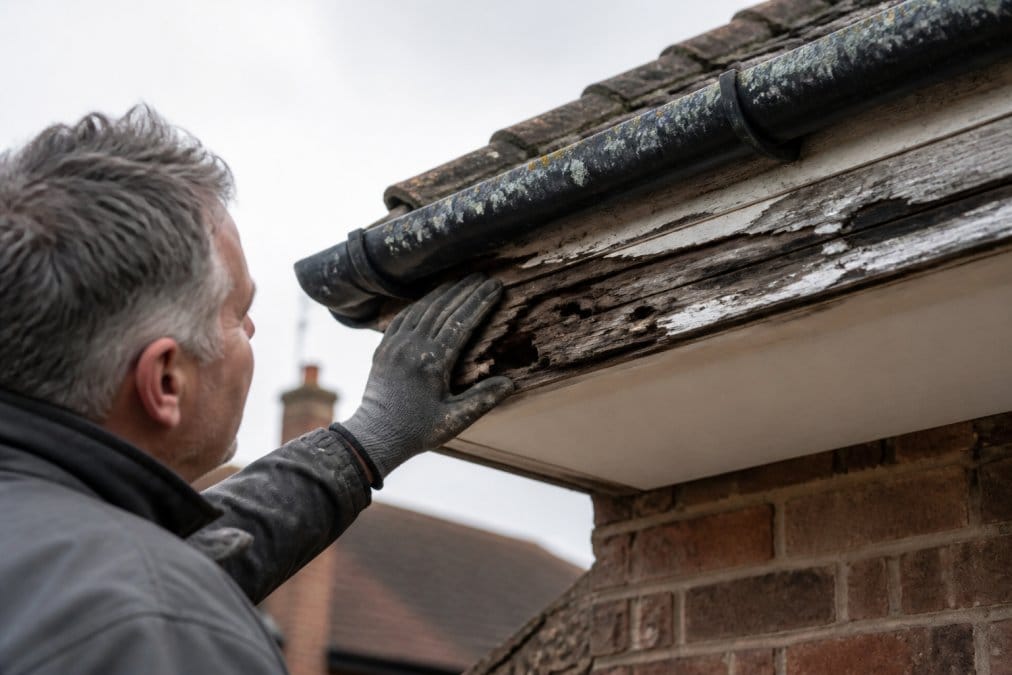
1. Flaking Paint and Cracked Timber
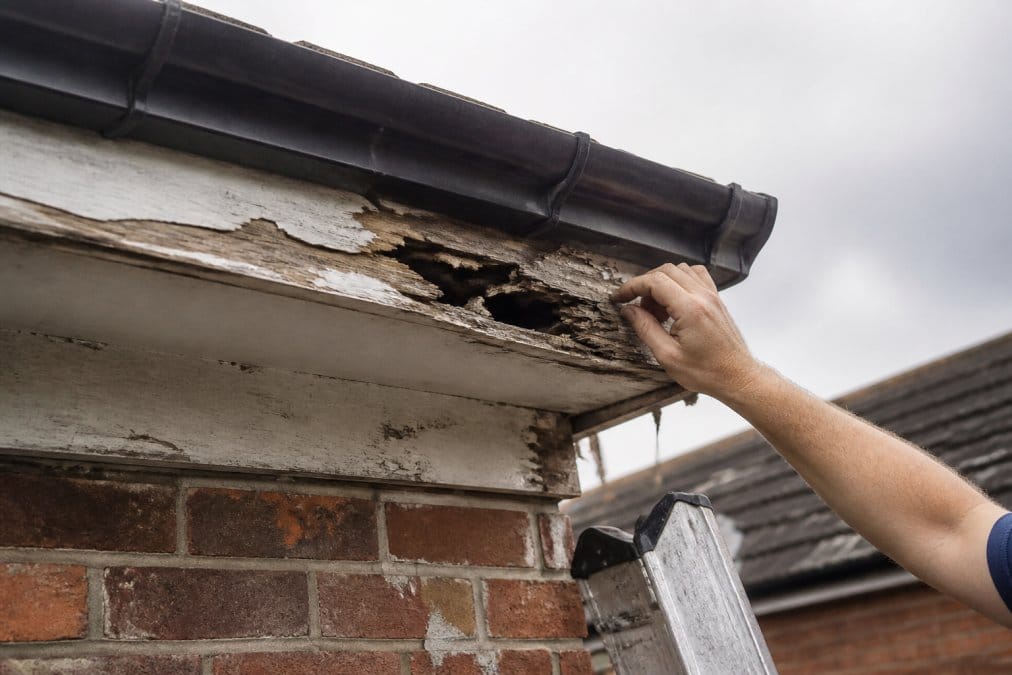
Paint that blisters and peels off a timber fascia is the earliest visible warning. Water has soaked into the board, the paint film has lost its grip, and the timber underneath is starting to move as it swells and shrinks.
Run a hand along the underside where you can reach safely. If the surface feels rough or the paint flakes away in sheets, the board is past the point where a fresh coat will help.
2. Soft, Crumbly or Spongy Boards
A healthy fascia is firm to the touch. Press a screwdriver into the board with light pressure: if it sinks in or crumbles, wet rot has taken hold and the timber has lost its structural strength.
This matters because the gutters are fixed to the fascia. A spongy board cannot hold the weight of a gutter full of rainwater, and that is when sections pull away from the roofline.
3. Water Stains, Damp Patches and Mould at the Eaves
Brown staining on the soffit, bubbling paint on the wall below, or dark mould at the eaves all point to water tracking behind the boards. The soffit is usually where this shows first because it sits directly under the roof edge.
If you can access the loft, look at the underside of the roof covering near the eaves. Damp timber or daylight coming through means the roofline has already failed.
4. Birds, Wasps and Squirrels Getting Under the Roofline
Gaps in the fascia and soffit give birds, wasps and squirrels an easy route into the roof space. Droppings on a windowsill, nesting material poking out at the eaves, or scratching sounds overhead are all signs the roofline is no longer sealed.
Pest entry is one of the more expensive signs to ignore. Once animals are inside, they tear at insulation and wiring, and the entry point has to be closed properly rather than patched.
5. Drooping Gutters and Loose Brackets
Gutters that sag, pull away from the wall, or leak at the joints usually mean the fascia behind them has softened. The brackets have nothing solid left to grip.
Check the gutter line from the end of the garden. A straight run that dips in one or two places is a reliable indicator that the board underneath has failed.
6. Visible Gaps Between Boards and the Wall
Daylight or a visible gap between the fascia and the brickwork means the board has shrunk, warped or come loose. This is common on older timber fascias that have been wet and dried repeatedly over many winters.
Gaps let wind-driven rain straight into the eaves, so they tend to accelerate the damage they came from.
7. Asbestos in Older Fascia Panels
Some properties built or refurbished between the 1950s and 1980s have asbestos cement fascia and soffit panels. These look similar to modern boards but are a serious health hazard if broken, drilled or sanded.
Do not disturb suspect panels. If you are unsure what your roofline is made of, arrange a professional survey before any work begins.
Watch Out
Never drill, cut or scrub a fascia you suspect contains asbestos. Disturbing the material releases fibres, and safe removal requires a licensed contractor. The cost of a survey is trivial next to the risk.
Never drill, cut or scrub a fascia you suspect contains asbestos. Disturbing the material releases fibres, and safe removal requires a licensed contractor. The cost of a survey is trivial next to the risk.
What Happens If You Ignore Damaged Fascias and Soffits
Ignoring damage at the roofline rarely stays a roofline problem. Water that gets past a failed fascia or soffit travels into the rafter feet, the wall plate and eventually the loft insulation and ceiling below.
The sequence is predictable. Rot weakens the timber, gutters pull loose, rainwater pours down the wall, and damp spreads into the masonry and internal plaster. What started as a board replacement becomes structural roof repair, replastering and possibly a full roofline replacement.
Get Your Free Roofing Quote Today! →
There is also a safety angle. A gutter full of water is heavy, and brackets fixed to rotten timber can give way without warning, particularly in high winds. If you have spotted any of the signs above, it is worth having the roofline inspected rather than waiting for the next storm to finish the job. Keeping the gutters clear with regular gutter cleaning helps slow the build-up of water that puts extra strain on the boards.
The Cost of Replacing Fascias and Soffits in the UK
The cost of replacing fascias and soffits in the UK depends on the size of the property, access requirements, the material chosen and whether the gutters are replaced at the same time. There is no single national figure, and any quote that arrives without a survey should be treated with caution.
For a typical semi-detached or detached home, the main variables are:
- Linear metres of roofline: the longer the run, the higher the material and labour cost
- Access: scaffolding on a two-storey property adds a significant fixed cost
- Material: uPVC is generally cheaper to install than hardwood or composite
- Gutters and downpipes: replacing these at the same time avoids paying for access twice
- Condition of the rafter feet: rotten timber behind the fascia needs remedial work before new boards go on
Why Quotes Vary So Much
Two roofers can quote very different figures for what sounds like the same job. The difference usually comes down to what is included: whether scaffolding is priced in, whether old boards are disposed of, whether the rafter ends are treated, and what guarantee is offered.
Ask for a written breakdown that separates labour, materials, access and waste removal. A quote that is vague on any of those points is not comparable to one that is not. Evershield Roofing provides free surveys and quotes so the scope is agreed before any work starts.
uPVC vs Timber Fascias: Which Should You Choose?
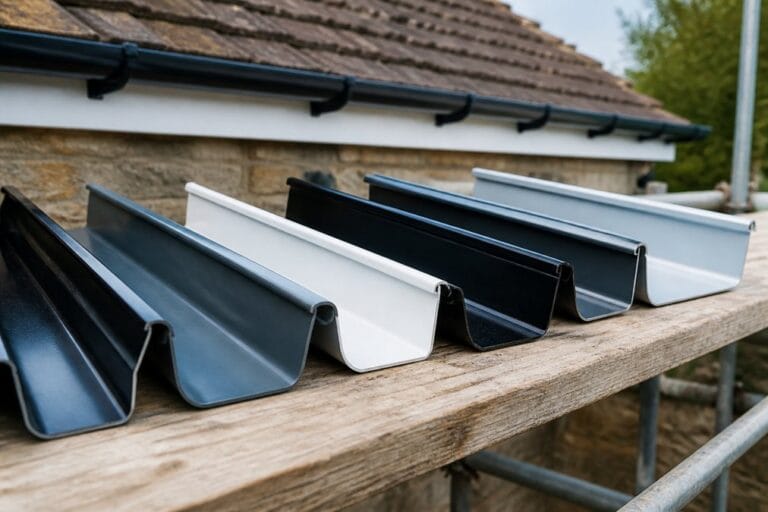
uPVC fascias are the better choice for most homes because they do not rot, need no repainting and carry long manufacturer guarantees when installed correctly. Timber fascias suit period and conservation properties where a painted finish is required, but they demand ongoing maintenance.
The trade-off is straightforward:
| Feature | uPVC Fascias | Timber Fascias |
|---|---|---|
| Rot resistance | Will not rot | Requires treatment and repainting |
| Maintenance | Occasional clean | Repaint every few years |
| Upfront cost | Higher material cost | Lower material cost |
| Lifespan | Decades with correct installation | Varies with maintenance |
| Best for | Most modern homes | Period and conservation properties |
For most homeowners dealing with damaged fascias, uPVC removes the maintenance cycle that caused the problem in the first place. Where a property sits in a conservation area, check what the local authority permits before specifying a material.
Pro Tip
Ventilation matters as much as the board itself. Soffit vents let the roof space breathe, and blocking them during a replacement traps moisture in the loft. Make sure your installer keeps the ventilation path open.
Ventilation matters as much as the board itself. Soffit vents let the roof space breathe, and blocking them during a replacement traps moisture in the loft. Make sure your installer keeps the ventilation path open.
How Long Do uPVC Fascias Last?
uPVC fascias typically last for several decades when installed correctly, with most manufacturers offering guarantees of ten years or more on registered installations. The board itself is rarely the weak point; poor installation is.
The failures we see most often are not material failures at all. They are boards fixed without the correct expansion gaps, gutters hung on brackets that are too far apart, or soffit vents blocked during fitting. Each of those shortens the life of the system regardless of how good the board is.
Buying on board thickness alone is a mistake. A slightly thicker board fitted badly will fail before a standard board fitted properly. If you are comparing quotes, ask what fixing system is used and how the ventilation is maintained.
Repair or Replace? How to Decide
Repair makes sense when damage is limited to one or two boards, the timber behind is sound, and the gutters are still firmly fixed. Replace when rot has spread along the run, the boards are soft across multiple sections, or the gutters are sagging because the fascia can no longer hold them.
Use this checklist to decide:
- Is the damage confined to one or two boards?
- Does a screwdriver press into the timber with light pressure?
- Are the gutters sagging in more than one place?
- Is there damp or mould inside the loft near the eaves?
- Are there visible gaps between the fascia and the wall?
- Are the boards more than 20 years old?
Two or more ticks on the lower half of that list usually points to replacement rather than repair. A professional survey will confirm it, and it is better to know before the next spell of heavy rain.
Water finding its way past a failed roofline is the kind of problem that gets worse while you wait, and by the time it reaches the ceiling the repair bill has grown with it. Evershield Roofing has worked on rooflines across London and Buckinghamshire for over 25 years, offering free surveys and quotes, fully insured work, finance from 0% APR, and emergency roof repair when water is already coming in. If you have spotted any of the seven signs above, get your free roofing quote today and have the roofline assessed before the next storm does it for you.
Frequently Asked Questions
How do I know if my fascias and soffits are rotting?
Press a screwdriver into the board. If it sinks in easily or crumbles, the timber has rotted. Look for flaking paint, dark patches, soft spots and a musty smell near the eaves. From ground level, check for cracked boards, gaps between the fascia and wall, or paint that has blistered and peeled. Any of these signs of damaged fascias and soffits means you should book a professional inspection before the rot spreads into the roof structure.
Can damaged fascias cause damp in my home?
Yes. Fascias and soffits seal the gap between the roof edge and the wall. Once they rot or shift, rainwater runs behind the boards and into the loft or wall cavity. You may notice damp patches on ceilings, mould near the eaves, or wet insulation. Fixing the roofline early usually costs far less than repairing water damage inside the property.
Is it worth repairing or replacing old timber fascias?
If only one or two boards have minor damage and the surrounding timber is sound, a repair can work. But when rot affects several sections, replacement is more cost-effective. uPVC fascias do not rot, need no painting and typically last 20 to 30 years, so many homeowners switch once the original timber reaches the end of its life. A free survey will confirm which option suits your property.
How often should fascias and soffits be replaced?
Timber fascias usually need replacing every 15 to 20 years if they are maintained with regular painting. uPVC fascias typically last 20 to 30 years with almost no upkeep. However, storm damage, blocked gutters or pest infestation can shorten that lifespan. Check your roofline every autumn, and after any severe weather, for the signs listed above.
What does replacing fascias and soffits cost in the UK?
The cost of replacing fascias and soffits in the UK depends on the size of your property, access equipment needed, and whether you choose uPVC or timber. A typical three-bed semi costs more than a bungalow because of the extra scaffolding and materials. Evershield Roofing offers free surveys and quotes, plus finance from 0% APR, so you get a clear figure before any work starts.