Best Materials for Flat Roof Waterproofing: 7 Options Compared
Compare seven flat roof waterproofing options, EPDM, GRP, felt, PVC and liquid-applied, by lifespan, cost and UK compliance.

Quick Summary
The best flat roof waterproofing material depends on roof shape, use and structure, and the main options are EPDM rubber, GRP fibreglass, bitumen felt, liquid-applied coatings and PVC single-ply. EPDM suits larger, more exposed domestic roofs, while GRP suits small, trafficked areas such as balconies and bays. A survey is the best way to match the material to your roof.
- EPDM rubber is flexible and suits larger, more exposed roofs with few joins.
- GRP fibreglass creates a hard, seamless finish around 3-4 mm thick.
- Polymer-modified bitumen felt typically lasts 10-15 years, per the cost table.
- Liquid-applied coatings suit roofs with irregular shapes and many penetrations.
- Compare quotes using whole-life cost, including maintenance, repairs and warranty terms.
Table of Contents
- Why Your Flat Roof Material Choice Matters
- Flat Roof Waterproofing Materials at a Glance
- EPDM vs GRP Flat Roof: Which Performs Better?
- Felt Flat Roof Lifespan and Why It Has Changed
- Liquid-Applied and PVC Systems for Complex Roofs
- Flat Roof Waterproofing Costs in the UK, Including Whole-Life Cost
- Keeping Your Flat Roof Membrane Maintained
- Booking a Flat Roof Survey and Choosing Your Material
- Frequently Asked Questions
Why Your Flat Roof Material Choice Matters
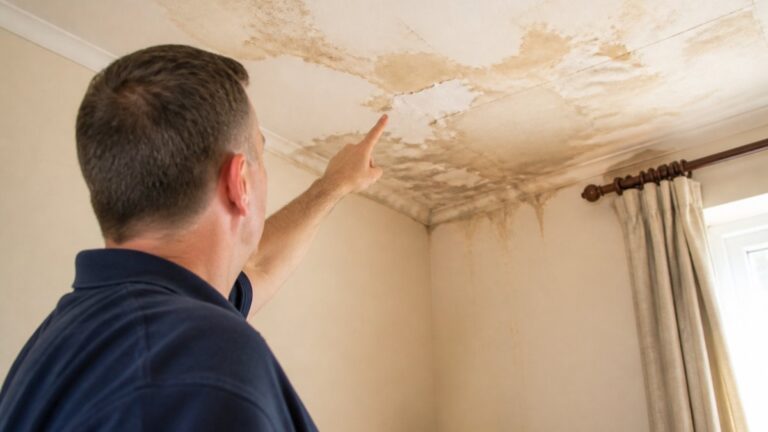
Choosing the wrong membrane is one of the most expensive mistakes a property owner can make on a flat roof. A flat roof has no natural fall to shed rainwater, so any weakness in the waterproofing layer lets water pool, soak into the deck and eventually reach the ceiling below. This pattern is common across Buckinghamshire, where a roof that looked fine from the ground can be failing from the inside.
The material you choose sets the expected lifespan, the repair options and the likely cost over the life of the roof. It also determines how well the system copes with foot traffic, UV exposure and the freeze-thaw cycles common in the UK. A cheap felt roof and a fully bonded single-ply membrane can look similar on day one but behave very differently after ten years.
Plenty of homeowners assume that a new coat of coating is always enough. In practice, the right choice depends on the roof’s structure, its size and how it will be used. Below, we compare seven options so you can match the material to your roof rather than to a sales pitch.
Flat Roof Waterproofing Materials at a Glance
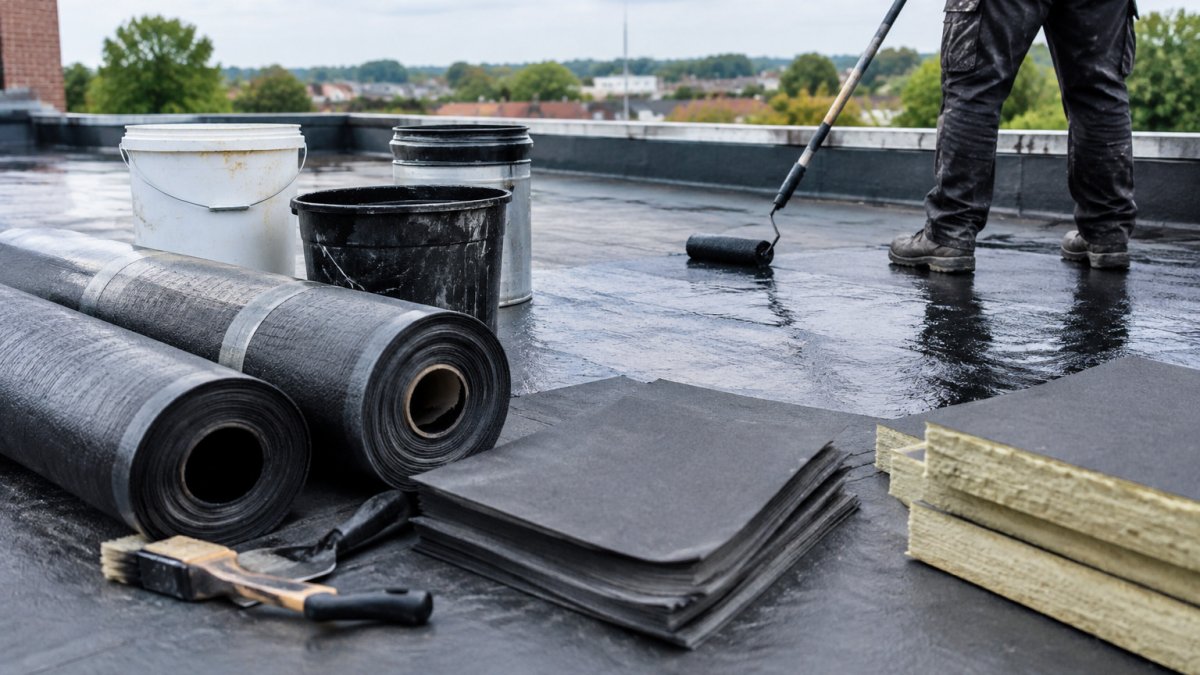
The main options fall into four groups: rubber membranes, fibreglass systems, bitumen-based felt and liquid-applied coatings. Each has a different installation method, and that affects both the finish and the disruption to the property.
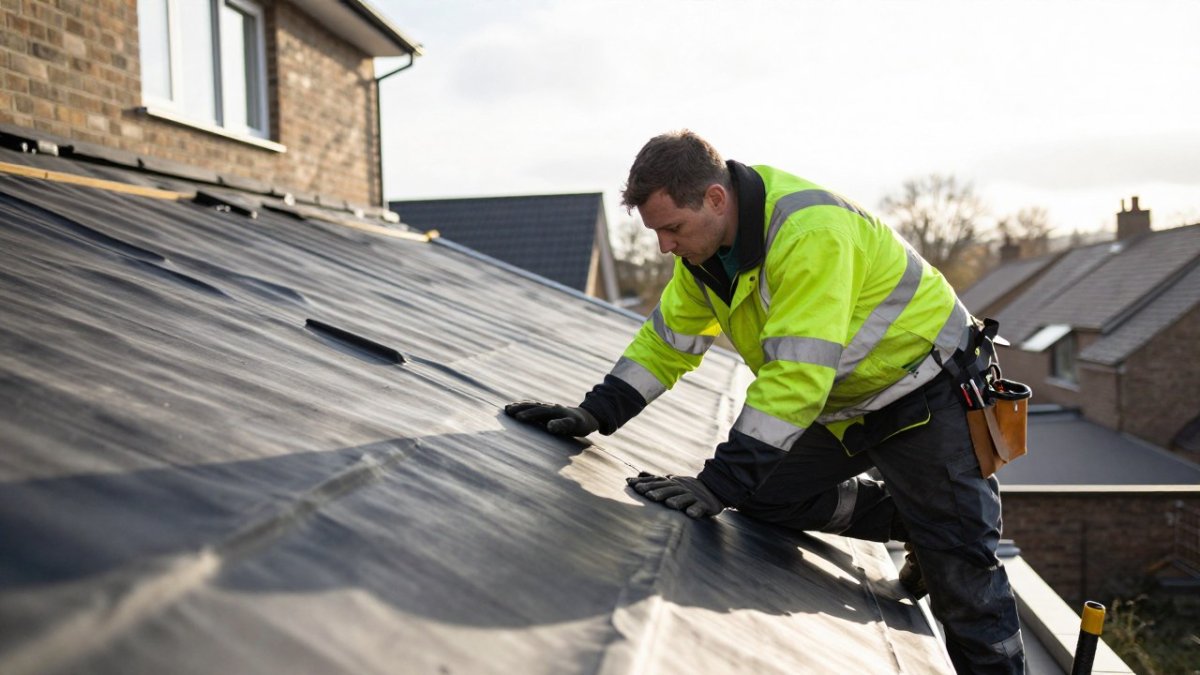
A roofer inspecting a rubber membrane on a flat roof is a useful reminder that the surface must be sound before anything is laid on top. Substrate condition matters as much as the product name.
| Material | Typical use | Installation | Key strength |
|---|---|---|---|
| EPDM rubber | Domestic and light commercial | Sheet, bonded or ballasted | Flexible, long track record |
| GRP fibreglass | Small roofs, balconies, bays | Layered resin and mat | Seamless, hard-wearing |
| Felt (bitumen) | Older and budget roofs | Torch-on or cold-applied | Low upfront cost |
| Liquid-applied | Irregular shapes | Brush or roller coating | Fast, good for repairs |
| PVC single-ply | Commercial flat roofs | Heat-welded sheet | Strong seams, UV resistant |
Each of these can work well when specified and fitted correctly. The difference lies in how they handle movement, detailing around upstands, and how easily they can be repaired.
EPDM vs GRP Flat Roof: Which Performs Better?
For most domestic flat roofs, EPDM rubber and GRP are the two options homeowners compare most often. Both are reliable when installed properly, but they suit different roofs, different buildings and different regulatory situations.
EPDM is a synthetic rubber sheet, typically 1.2-1.5 mm thick, supplied in large sheets so a domestic roof can often be covered with few or no joins. It stays flexible from about -40°C to +80°C, which handles the expansion and contraction of UK roofs and the freeze-thaw cycles common in Buckinghamshire and London.
GRP, or glass-reinforced plastic, is built up on site in layers of polyester resin and fibreglass matting over a primed deck. It creates a hard, seamless finish around 3-4 mm thick that tolerates foot traffic better than most membranes and is popular for balconies, bays and small regular roofs.
Building regulations and fire performance. Fire classification is an important consideration for flat roofs, including domestic extensions and roofs close to boundaries. Relevant guidance includes the Building Regulations fire safety requirements, which can apply to roof coverings depending on height, use and proximity to boundaries. EPDM and GRP are not automatically compliant in every situation; the specification, substrate and build-up determine the classification.
Roof construction and compatibility. The deck matters as much as the membrane. GRP needs a sound, dry OSB or plywood deck and is sensitive to moisture during curing; EPDM can be laid over most sound decks, including existing felt in some overlay situations, provided the surface is prepared.
Local conditions. In London, where roofs are often smaller, overlooked and accessed via party walls, EPDM’s single-sheet installation reduces seams and disruption; GRP’s hard finish suits roof terraces and balconies but adds curing time and odour. In Buckinghamshire, larger and more exposed roofs favour EPDM’s flexibility, while GRP remains a good fit for porches, bays and small extensions.
Repairability and failure modes. EPDM failures usually involve seam separation, punctures or detail lifting, and repairs are straightforward with compatible patches. GRP failures tend to be cracking at details, blistering from moisture trapped during lay-up, or UV degradation of the topcoat; repairs are possible but require grinding back and re-laminating. In both cases, regular inspection catches problems early.
EPDM is often considered well suited to larger, more exposed roofs, while GRP is commonly chosen for small, trafficked areas. For a deeper look at rubber options, read the rubber roofing guide. Neither is a universal winner, so the right answer depends on the shape, use and regulatory context of your roof.
Felt Flat Roof Lifespan and Why It Has Changed
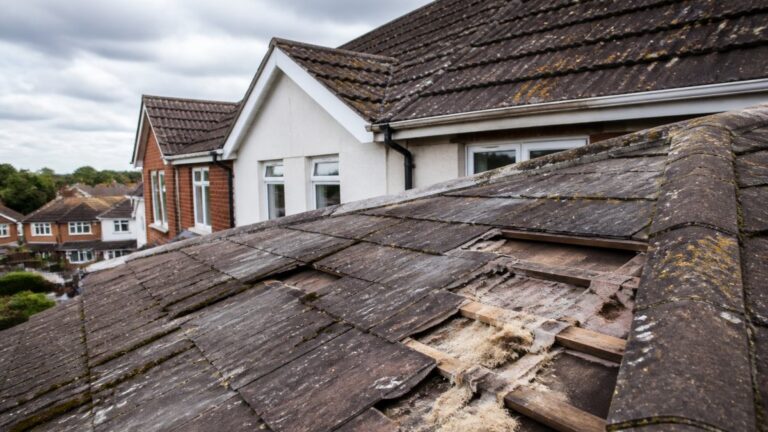
Traditional bitumen felt was the default for flat roofs for decades. Many roofs installed in that era are still in service, though most are reaching the end of their useful life. Modern felt products are more durable than older versions, but they still age faster than rubber or single-ply systems exposed to the same weather.
The main reasons felt has changed are manufacturing improvements and better installation practice. Polymer-modified bitumen membranes resist cracking and blistering better than the basic felts of the past. Poor laying, however, still causes most early failures, including inadequate laps, weak detailing at edges and trapped moisture beneath the membrane.
Felt remains a sensible choice for some budget projects, particularly small roofs with simple shapes. For a comparison of how flat roofs stack up against tiled roofs for durability, see flat roof vs tiled roof durability. Its lifespan is shorter than most alternatives, so the total cost of ownership needs to be considered, not just the price of the initial installation.
Get Your Free Roofing Quote Today! →
Liquid-Applied and PVC Systems for Complex Roofs
Roofs with awkward shapes, many penetrations or lots of upstands are often better suited to liquid-applied systems. These coatings are brushed or rolled on in several layers, forming a seamless membrane that follows every contour. They can also be applied over existing roofs in some cases, which reduces removal costs.
Liquid-applied products vary widely in chemistry, so the specification matters. They need dry conditions during application and adequate curing time before the roof is used. A common mistake is applying too thin a coat, which reduces both water resistance and lifespan.
PVC single-ply membranes are mainly used on commercial flat roofs. The sheets are heat-welded at the seams, creating strong, durable joints, and the membrane resists UV and chemical exposure well. For a domestic roof, PVC is rarely the first choice, but it is worth knowing about if you manage a larger building.
Flat Roof Waterproofing Costs in the UK, Including Whole-Life Cost
Cost depends on the roof’s size, access, deck condition and the chosen system, so no responsible contractor publishes a single fixed price. What you can do is compare systems on a like-for-like basis using indicative installed rates and a simple whole-life calculation. Pricing depends on roof size, access, deck condition and the chosen system, so please contact Evershield Roofing or visit our pricing page for current prices or a quote.
| System | Indicative installed cost per m² (GBP) | Typical service life | Maintenance pattern |
|---|---|---|---|
| EPDM rubber (single sheet) | £45-£75 | 20-30 years | Annual inspection; occasional seam or detail repair |
| GRP fibreglass | £60-£100 | 20-25 years | Annual inspection; UV topcoat refresh at 10-15 years |
| Polymer-modified bitumen felt | £35-£60 | 10-15 years | Annual inspection; local repairs from year 8-10 |
| Liquid-applied PU/acrylic | £50-£90 | 10-20 years (chemistry-dependent) | Annual inspection; recoat at manufacturer interval |
| PVC single-ply | £55-£95 | 20-30 years | Annual inspection; heat-welded repairs |
Whole-life cost is a useful basis for comparison. Use this method: (installed cost) + (expected maintenance over life) + (likely repairs) + (replacement cost discounted by lifespan). Ask each contractor for the system’s expected service life, the maintenance schedule, and the warranty terms in writing so you can run the same calculation across quotes.
Watch out: quotes can exclude deck repairs, fascia replacement or scaffold, so ask for these to be itemised before comparing totals.
Regional factors matter. Access and local conditions can affect the project, so ask your contractor to price these in. Both regions see enough rainfall and freeze-thaw cycling that drainage design and fall should be priced in, not treated as an extra.
Keeping Your Flat Roof Membrane Maintained
Most membrane failures are preventable. Regular checks help you catch small problems before they become leaks. Clear drainage outlets, gutters and gullies, because standing water accelerates wear on any flat roof system.
Inspect the surface at least twice a year, and after storms. Look for blisters, splits, loose edges, ponding water and damage around pipes and upstands. To know what early warning signs of water damage look like, see signs of roof water damage to check. Remove debris, moss and leaves, and avoid walking on the roof unless it is designed for foot traffic.
Watch out: never repair a membrane with an incompatible product, such as applying a coating over bitumen without checking compatibility. Mismatched materials can cause the new layer to peel within a season.
Booking a Flat Roof Survey and Choosing Your Material
The right material depends on a proper inspection, not a guess from the pavement. A survey shows the condition of the deck, the drainage, the number of penetrations and how the roof meets the walls. It also tells you whether the existing covering can be overlaid or must be stripped back.
Evershield Roofing offers free surveys and quotes, so you can compare options without commitment. Our team is available by phone to answer questions at any stage.
Book a survey to find out which flat roof waterproofing material suits your property, and get your free roofing quote today.
Frequently Asked Questions
What is the best material for waterproofing a flat roof in the UK?
For most domestic flat roofs in the UK, EPDM rubber and GRP fibreglass are the two strongest choices, because both form a seamless, watertight membrane suited to typical roof spans. EPDM suits larger, lower-pitch roofs and is flexible in cold weather, while GRP is rigid, hard-wearing and well suited to smaller roofs with foot traffic. Felt remains common but generally has a shorter working life. The right answer depends on roof size, access, budget and the condition of the existing deck, so a site survey is the reliable way to confirm the best option for your property.
Is EPDM or GRP better for a flat roof?
Neither is universally better. EPDM handles larger areas well and tolerates movement, which makes it a common choice for bigger flat roofs. GRP cures to a hard, smooth surface, is more durable under foot traffic and works well on smaller, more complex shapes with upstands and edges. When comparing EPDM vs GRP flat roof options, look at roof size, how often the roof will be walked on, and the installer’s experience with each system. Ask for both to be quoted so you can compare like for like.
How long do flat roof waterproofing materials last?
Lifespan varies with the material, workmanship and exposure. Well-installed EPDM and GRP membranes commonly last several decades when properly maintained, while traditional felt flat roofs typically have a shorter working life and often need replacing sooner. Liquid-applied systems can last well when correctly prepared and recoated. Felt flat roof lifespan is usually the shortest of the main options, so regular inspection of any felt roof is sensible. Manufacturer warranties and installer guarantees give a better guide for your specific product.
Can you waterproof an existing flat roof without replacing it?
In many cases, yes. A liquid-applied coating or an overlay membrane can often be installed over a sound existing deck, provided the substrate is structurally sound, dry and free of major defects. Some roofs, however, have trapped moisture, rotten timber or failed insulation, and these usually need full replacement. A survey will establish whether overlaying is viable. Evershield Roofing offers free surveys and quotes, so you can get an honest assessment before committing to either route.