7 Gutter Guards for Terraced Houses: What Actually Works
Gutter guards for terraced houses cut blockages and overflow. Compare hedgehog, mesh and brush types, shared gutter duties and replacement costs.

Last Updated: November 21, 2026
Quick Summary
Gutter guards for terraced houses are barriers fitted over or into a shared gutter run that let rainwater in while keeping leaves, moss and debris out. Micro-mesh guards, with a weave around 1mm or less, are a common choice on terraces because they sit flat and cope with moss shed by older concrete tiles. Check your deeds first, as a shared gutter’s maintenance is usually defined there and often shared.
- A clogged gutter on a terrace can send water into two or three homes at once.
- Micro-mesh uses a weave of around 1mm or less to hold back moss granules and grit.
- Gutter hedgehogs let fine moss pass through and trap silt in the bristles over time.
- UK domestic guttering commonly runs at 100mm or 115mm, in half-round, square or ogee profiles.
- Add an outlet guard at the downpipe as well as mesh along the channel to protect both stages.
Guards or replacement first?We survey your roofline and tell you honestly what your gutters need.
Table of Contents
- Why Gutter Guards Matter More on a Terraced House
- The Main Types of Gutter Guard Explained
- Gutter Hedgehog vs Mesh Guards: Which Suits Your Roofline
- Shared Gutter Maintenance Responsibilities on a Terrace
- Fitting Guards: Gutter Profiles, Sizes and Safe Access
- Heavy Rain, Overflow and Outlet Guards
- The Cost of Guttering Replacement UK Homeowners Should Budget For
- Book a Gutter Survey Before the Next Storm
- Frequently Asked Questions
Why Gutter Guards Matter More on a Terraced House
Gutter guards for terraced houses solve a problem that detached homes simply do not have: one continuous roofline serving several households, where a single blocked section can send water into two or three homes at once. The pattern across terraced rooflines is consistent. On a terrace, a clogged gutter rarely damages just the property beneath it.
The reason is structural. A terraced house shares its gutter run with neighbours, and the fall of that run often drains across property boundaries.
The guard options below are the main types used on shared, storm-exposed rooflines.
The Main Types of Gutter Guard Explained
A gutter guard is a barrier fitted over or into a gutter that lets rainwater in while keeping leaves, moss and debris out. The type you choose determines how much maintenance the gutter still needs and how well it copes with a British downpour.
Mesh and Micro-Mesh Guards
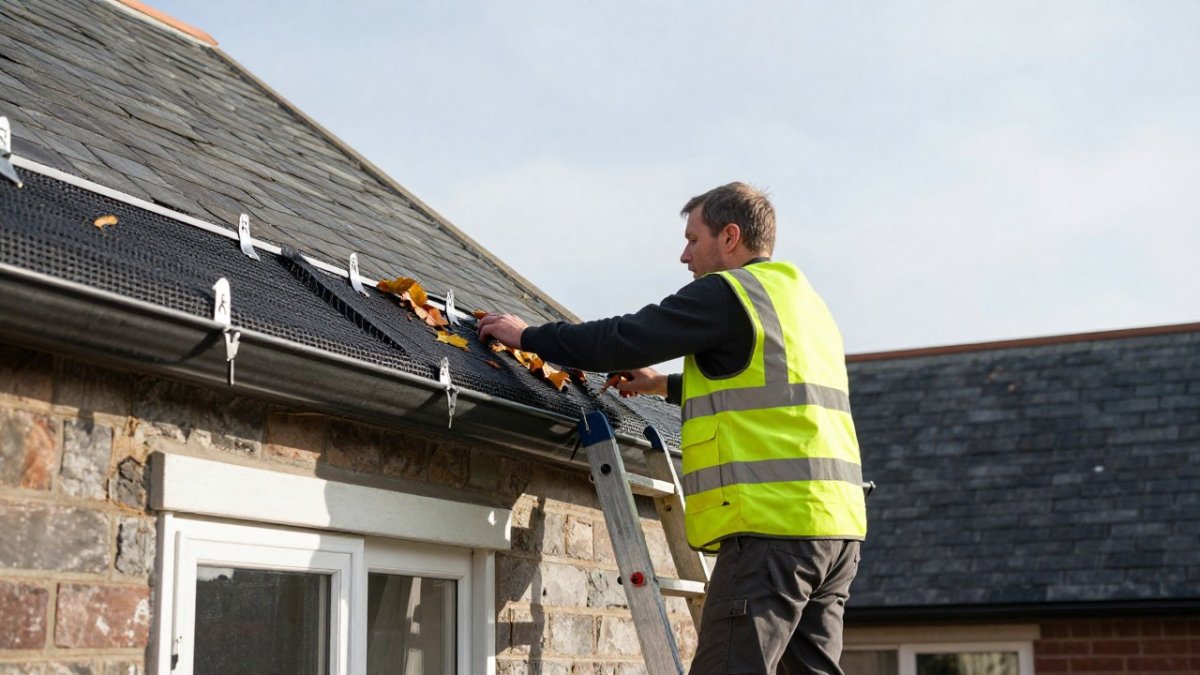
Mesh guards use a stainless or plastic screen clipped over the gutter mouth. Micro-mesh uses a far finer weave, typically around 1mm or less, which also holds back moss granules and roof grit. It is a common choice for terraced houses because it sits flat and lets water through. Prices vary by profile and length, so check our guttering services for a current quote.
Solid Covers, Reverse-Curve and Foam Inserts
Solid covers and reverse-curve guards rely on surface tension to pull water around a curved lip while debris slides off. They generally need to be fitted at the correct pitch to work well. Foam inserts and brush guards are often cheaper and easier to fit, but they can clog with fine moss and be awkward to clean on a high roofline.
Here are the main guard types used on shared, storm-exposed terraced rooflines, and how they differ.
| Option | Best for | Key difference |
|---|---|---|
| Mesh and micro-mesh guards | Terraced houses; older concrete tiles shedding moss | Sits flat; micro-mesh weave around 1mm or less |
| Solid covers and reverse-curve | Gutters needing correct pitch | Surface tension pulls water around curved lip |
| Foam inserts and brush guards | Cheaper, easier fitting | Can clog with fine moss; awkward to clean high up |
| Gutter hedgehog | Low, accessible gutter on a garden building | Cylindrical brush inside channel; fine moss passes through |
Gutter Hedgehog vs Mesh Guards: Which Suits Your Roofline
The gutter hedgehog is a cylindrical brush that sits inside the channel, while mesh guards cover the top. Hedgehogs are cheap and quick to fit, but fine moss passes straight through and the bristles trap silt over time.
Mesh is often preferred on a terraced roofline for a few reasons, including that it does not need lifting out to clean and can cope with the moss shed by older concrete tiles.
A hedgehog may suit a low, accessible gutter on a garden building.
Shared Gutter Maintenance Responsibilities on a Terrace
Shared gutter maintenance responsibilities on a terrace are the single most misunderstood part of ownership. Where a gutter or downpipe serves two or more homes, responsibility is usually defined in the deeds or lease, and it is often shared. guidance on maintaining your property is clear that gutter clearance sits with the owner, but on a terrace the consequences are rarely confined to one owner.
Check the deeds before you touch the gutter
Before fitting anything, check your title documents. Look for covenants, easements and any party-wall or shared-drainage clauses. If the gutter is shared, the deeds or lease usually set out who maintains what and how costs are split. If the wording is unclear, a solicitor or a licensed conveyancer can interpret it; do not rely on a neighbour’s recollection.
Agree the work in writing
A short written note confirming who is paying for what prevents most disputes. Set out the scope (for example, clearing the run and fitting micro-mesh over the shared section), the contractor, the date, the cost split and who will be home for access. A simple email or signed note is enough. If a neighbour will not agree, you can still maintain the section serving your own property, but you should not alter a shared section without consent.
Handle access and disputes
Access is the flashpoint on terraces. Equipment often needs to stand on a shared passageway or in a neighbour’s garden. Ask in advance and confirm it in writing. If a shared gutter is blocked and a neighbour refuses to act, the practical route is to document the problem with dated photos, put your request in writing, and seek mediation before considering legal action. Disputes over access and cost are common, and a short written note confirming who is paying for what prevents most of them.
Keep records and plan for repeat work
Keep receipts, photos and the written agreement. Guards reduce maintenance but do not eliminate it, so agree a simple inspection routine, for example checking the outlets after autumn and clearing any debris from the mesh. Regular cleaning remains the backbone of protection, and how regular gutter cleaning protects your roof explains what neglect actually costs.
Fitting Guards: Gutter Profiles, Sizes and Safe Access
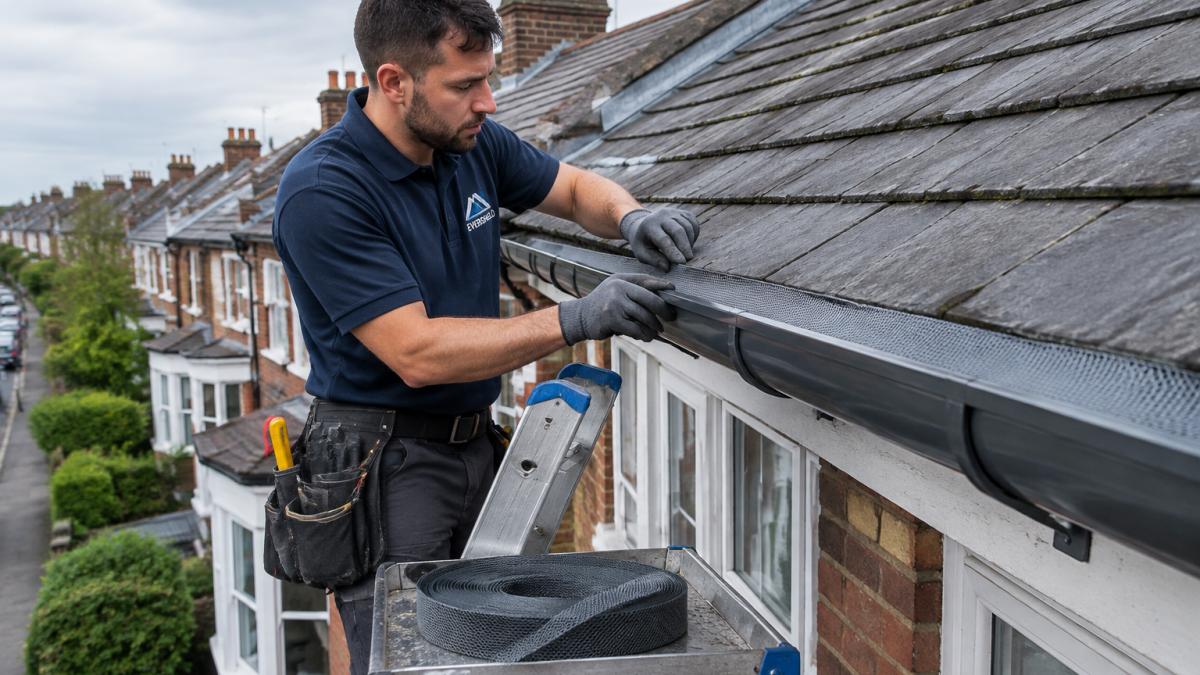
Fitting a guard starts with the gutter profile, not the guard. UK domestic guttering commonly runs at 100mm or 115mm, and profiles vary between half-round, square and ogee. A guard must match the profile and the clip spacing, or it will lift in wind. A guard made for one gutter profile will generally not seat correctly on a different profile or width, so measure the channel width and the profile shape before ordering anything.
Match the guard to the gutter profile
- Half-round (100mm or 115mm): the most common profile on Victorian and Edwardian terraces. A flat micro-mesh panel clipped over the lip works well because the curved base sheds debris and the mesh sits flush. Avoid brush or hedgehog inserts here if the run is long and high, because silt collects at the base of the curve.
- Square-line: common on 1930s and post-war terraces. The flat face and right-angled lip suit a clip-on mesh or a solid cover, but check that the guard does not sit proud of the fascia, or it will catch wind.
- Ogee: often found on 1960s-1980s terraces. The decorative front lip makes clip-on guards less secure, so specify a guard with a purpose-made ogee clip or a reverse-curve cover fitted at the correct pitch.
- Cast iron and older profiles: many period terraces in London and Buckinghamshire still have cast-iron or asbestos-cement gutters. Guards can be fitted, but brackets and clips may need replacement first, and drilling old cast iron risks cracking it.
Match the guard to the roof edge and debris type
Look at what actually lands in the gutter. A terrace under lime or sycamore gets large leaves and twigs, which a standard mesh handles well. A roof with older concrete tiles sheds moss granules and grit, which pass through coarse mesh and clog the channel, so micro-mesh (around 1mm or finer) is the better specification. Even the right cover needs occasional checks for trapped grit and moss, so keep the gutter and fascia cleaner in mind when planning maintenance around the roof edge.
Plan safe access before you buy
Safe access matters more than speed. Working at height on a ladder against a terraced façade, often over a shared passageway, carries real risk. On a long continuous run, fit from a tower or platform rather than leapfrogging a ladder.
Watch out: forcing a guard onto a mismatched profile can cause it to lift in a storm and take the gutter clips with it. If the profile is unclear, take a short offcut or a photo to the supplier rather than guessing.
Heavy Rain, Overflow and Outlet Guards
Heavy rain exposes every weakness in a gutter system, and the outlet is where it shows first. An outlet guard, sometimes called a wire balloon, fits over the downpipe mouth to stop debris entering the pipe while letting water drain freely.
On a terraced run, the outlet is often the choke point. If you want to compare systems built for storm conditions, our guide to the 5 best durable guttering systems for heavy rain sets out the options. For flooding risk specifically, preventing basement flooding with gutter maintenance covers what backed-up water does to a lower ground floor.
The Cost of Guttering Replacement UK Homeowners Should Budget For
Replacement costs depend on run length, access, profile and whether fascia or soffit work is needed, so we quote each property individually rather than publish a figure that will not hold. What we can say is that guards are almost always cheaper than replacing a rotted run.
Our breakdown of the cost of installing heavy duty guttering explains what drives the price. If your gutters are already sagging, split or pulling away from the fascia, guards will not fix that. Repair or replacement comes first.
Book a Gutter Survey Before the Next Storm
The gap between a working gutter and a flooded hallway is usually one autumn of blocked leaves. Guards reduce that risk, but only when specified for your profile, your rainfall exposure and your shared run.
Evershield Roofing offers free surveys and quotes, with fully insured teams and finance available from 0% APR. We handle guttering, fascia and soffit replacement, roof repairs and emergency call-outs, and we can advise on whether guards are worth fitting on your roofline. Get started with Evershield Roofing and protect your terrace before the next storm.
Frequently Asked Questions
Are gutter guards effective for terraced houses in the UK?
They help, but they are not fit-and-forget. Mesh and micro-mesh guards keep the majority of leaves and moss out of the channel, which cuts how often you need to clear a blockage. On a terrace the bigger problem is often shared outlets and downpipes, so pair any guard with outlet protection. Guards still need occasional brushing, and cheap foam inserts can hold water and moss, so choose the type around your roof and debris rather than the lowest price.
Who is responsible for cleaning shared gutters in a terraced property?
Where a gutter serves more than one home, the responsibility is normally shared between the freeholders or leaseholders who benefit from it. Check your title deeds, lease or transfer document first, because some set out exact repair and cost-sharing terms. If nothing is written down, the practical route is to agree a split in writing with your neighbour before work starts. Persistent disputes over shared guttering can be raised with the local authority, and legal advice is worth taking where the deeds are unclear.
How much do gutter guards cost to install in Buckinghamshire?
There is no single figure, because the price depends on the length of guttering, the guard type, the number of storeys and whether access equipment is needed. Micro-mesh and solid covers cost more per metre than brush or hedgehog inserts but usually last longer. Evershield Roofing surveys the roofline for free and quotes against the actual run of gutter, so you get a figure for your property rather than a national average. Current pricing is listed on the Evershield website.
Do gutter guards prevent water damage to terraced rooflines?
Guards reduce the risk by keeping channels clear so rainwater drains away instead of backing up under the fascia and into the wall. They cannot fix a gutter that has already dropped, a cracked section or an undersized downpipe, and those are common causes of overflow on older terraces. Have the guttering and fascias checked before fitting guards; if the channel is sound and correctly falls to the outlet, a guard plus an outlet guard gives the roofline the best protection in heavy rain.